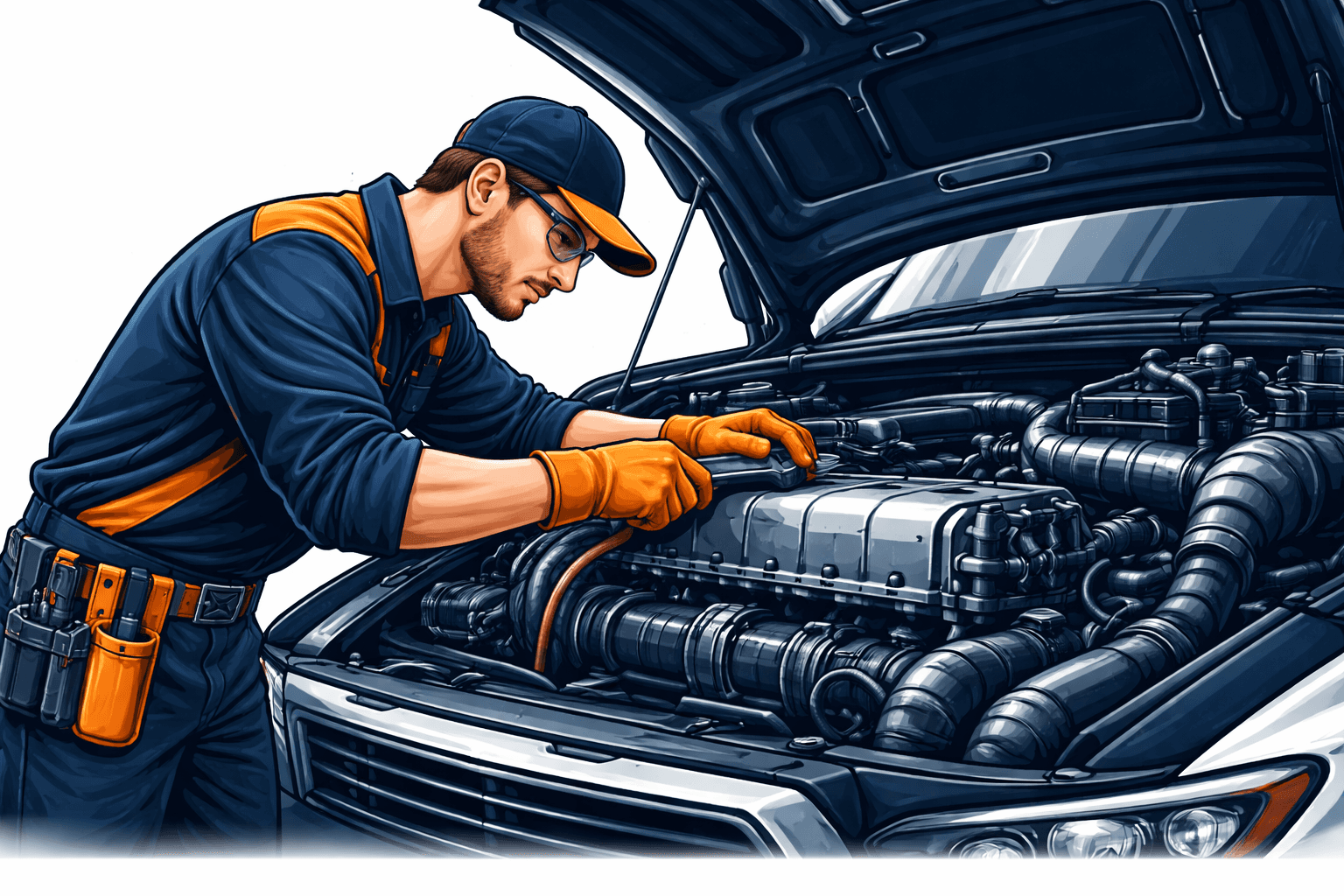
I've replaced more radiators than I can count, and I've also seen more blown head gaskets from people ignoring their cooling system than I'd like to admit. Your radiator is one of those parts most people never think about until their temperature gauge is in the red and steam is pouring out from under the hood. Let me walk you through how it works so you understand why it matters.
What a Radiator Actually Does
Your engine creates a massive amount of heat when it runs. We're talking combustion temperatures over 4,000 degrees Fahrenheit inside the cylinders. Without a way to get rid of that heat, your engine would destroy itself in minutes. That's where the radiator comes in.
Think of the radiator as your engine's air conditioner. It takes hot coolant from the engine, spreads it out across a huge surface area of thin tubes and fins, and lets air flowing through it carry the heat away. The cooled-down coolant then goes back into the engine to absorb more heat, and the cycle repeats over and over.
The radiator sits right at the front of your car, behind the grille. That location is intentional - it gets maximum airflow when you're driving. When you're sitting in traffic and there's no airflow, electric cooling fans kick on to pull air through the radiator. Between the radiator, the coolant, and the fans, your engine stays in that sweet spot between 195 and 220 degrees Fahrenheit.
How Coolant Flows Through Your Engine
The cooling system is a closed loop. Here's how the coolant travels, step by step:
Step 1: The Water Pump. This is the heart of the system. It's a mechanical pump driven by the engine (via a belt or the timing chain) that pushes coolant through the entire loop. Without it, coolant just sits there and your engine overheats fast.
Step 2: Through the Engine Block and Heads. The water pump pushes coolant into passages cast right into the engine block and cylinder heads. These passages - called water jackets - surround the cylinders and combustion chambers where all that heat is being generated. The coolant absorbs that heat as it flows through.
Step 3: The Thermostat. After picking up heat from the engine, the coolant reaches the thermostat. This is a temperature-controlled valve. When the engine is cold, the thermostat stays closed, keeping coolant circulating only inside the engine so it warms up quickly. Once the engine hits operating temperature (usually around 195 degrees), the thermostat opens and lets hot coolant flow out to the radiator.
Step 4: The Radiator. Hot coolant enters the radiator through the upper hose and flows through dozens of thin aluminum tubes. Between these tubes are thousands of tiny fins - like an accordion of thin metal. Air passes through these fins and carries the heat away. By the time coolant reaches the bottom of the radiator, it's been cooled down significantly.
Step 5: Back to the Water Pump. Cooled coolant exits the radiator through the lower hose and returns to the water pump, where the cycle starts all over again. This loop happens continuously while your engine is running.
The whole system also connects to your heater core - a small radiator inside the dashboard. When you turn on your heat, hot coolant flows through the heater core and a fan blows that warmth into the cabin. That's why your heat doesn't work well until the engine warms up.
Parts of the Radiator and Cooling System
Radiator Core. This is the main body - the grid of tubes and fins where heat exchange happens. Modern radiators use aluminum cores because aluminum transfers heat efficiently and is lightweight. Older vehicles used copper and brass radiators, which were heavier but could be repaired more easily.
Radiator Tanks. These are the containers on each side (or top and bottom) of the core where coolant enters and exits. On most modern cars, these tanks are made of plastic crimped onto the aluminum core. That plastic-to-aluminum junction is a common leak point after years of heat cycling.
Radiator Cap. Don't let the simplicity fool you - the radiator cap is a precision pressure valve. It maintains system pressure at around 13 to 16 PSI. Here's why that matters: for every pound of pressure, the boiling point of your coolant goes up about 3 degrees. So a 15 PSI cap raises the boiling point by about 45 degrees. That's the difference between your coolant boiling over in traffic and staying liquid.
Overflow Tank (Coolant Reservoir). As coolant heats up, it expands. The overflow tank gives it somewhere to go. When the system cools back down, the coolant gets sucked back into the radiator. This tank is where you check your coolant level - look for the "MIN" and "MAX" lines on the side. You should never need to open the radiator cap to check your level on a modern car.
Cooling Fans. Most modern vehicles have one or two electric fans mounted to the back of the radiator. They kick on automatically when coolant temperature rises above a certain point or when you turn on the AC. Some older trucks and cars use a mechanical fan attached to the water pump with a clutch that engages when things get hot.
Hoses. The upper and lower radiator hoses connect the radiator to the engine. They're made of rubber reinforced with fabric or wire. Over time, they deteriorate from the inside out - they might look fine on the outside but be falling apart internally. I've seen hoses collapse under suction from the water pump because the inner lining was gone. Most manufacturers recommend replacing hoses every 5 to 7 years.
Types of Coolant and Why It Matters
Not all coolant is the same, and using the wrong type can actually damage your cooling system. Here's what you need to know.
IAT (Inorganic Acid Technology) - Green. This is the traditional green coolant that's been around forever. It uses silicate and phosphate additives to protect against corrosion. It works well but needs to be replaced every 2 to 3 years or 30,000 miles because those additives wear out. You'll mostly see this in older American vehicles.
OAT (Organic Acid Technology) - Orange/Red. GM introduced DexCool in the mid-1990s, and it's the most common OAT coolant. It uses organic acids for corrosion protection and lasts longer - typically 5 years or 150,000 miles. Many modern vehicles from various manufacturers use OAT-based coolants now, though the color varies. Toyota uses a red/pink OAT, for example.
HOAT (Hybrid Organic Acid Technology) - Yellow/Pink/Blue. This is a blend of IAT and OAT technologies. Different manufacturers have their own versions. Ford uses a yellow HOAT, European vehicles often use a pink or blue version. It typically lasts about 5 years.
The Golden Rule. Use what your owner's manual says. Don't mix types. If someone topped off your cooling system with the wrong coolant at some point, get a full flush done to clean everything out and start fresh with the correct type. Mixing OAT and IAT coolants can cause the mixture to gel up and clog your heater core and radiator passages.
Also - always use a 50/50 mix of coolant concentrate and distilled water (or buy the pre-mixed version). Straight coolant actually doesn't transfer heat as well as a 50/50 mix, and it doesn't protect against freezing as well either. The mix is the sweet spot.
Common Radiator Problems
These are the radiator and cooling system failures I see most often:
Radiator Leaks. The number one radiator problem. Leaks usually happen at the seam where the plastic tanks meet the aluminum core. You might see green, orange, or pink fluid dripping under the front of your car, or notice your coolant level keeps dropping. Small leaks can sometimes be spotted as white crusty deposits on the radiator. If you're losing coolant but don't see a puddle, the leak might only happen when the system is hot and pressurized - so it evaporates before it hits the ground.
Internal Clogs. Over time, rust, scale, and degraded coolant additives can clog the tiny passages inside the radiator. When passages are blocked, coolant can't flow properly, and it can't shed heat fast enough. The engine runs hotter than normal, especially in traffic or on hot days. A coolant flush can help prevent this, but once a radiator is severely clogged, replacement is usually the answer.
Cooling Fan Failure. If your electric cooling fan stops working, you'll overheat in traffic or at idle but be fine on the highway (because highway speed forces air through the radiator). Fan failures are usually caused by a bad fan motor, a blown fuse, a bad temperature sensor, or a faulty fan relay. This is one of the easier cooling problems to diagnose - just watch if the fan comes on when the engine gets hot.
Thermostat Stuck Closed. When a thermostat fails in the closed position, it blocks coolant from reaching the radiator entirely. Your temperature gauge climbs fast, and you'll overheat quickly. The good news: thermostats are usually $15 to $40 for the part, and labor is $100 to $250 on most vehicles. I always replace the thermostat when doing a cooling system repair - it's cheap insurance.
Water Pump Failure. If the water pump bearing wears out or the impeller corrodes away, coolant doesn't circulate. Symptoms include overheating, coolant leaking from the weep hole on the pump, or a grinding/whining noise from the front of the engine. Water pump replacement is $300 to $800 on most vehicles.
For a deeper dive into overheating causes and what to do when your temperature gauge goes red, check out our diagnostic tools at APEX Tech Nation.
Radiator Maintenance Tips
The cooling system is one of the most neglected systems on most cars. Here's how to stay ahead of problems:
Check your coolant level regularly. Once a month, look at the overflow reservoir when the engine is cold. The level should be between the MIN and MAX lines. If it's consistently low, you have a leak somewhere - even if you don't see drips.
Get a coolant flush on schedule. Follow your manufacturer's recommended interval. For most vehicles, that's every 30,000 to 60,000 miles or every 5 years, whichever comes first. A flush removes old coolant along with any rust, scale, and debris that's built up. Fresh coolant has fresh corrosion inhibitors that protect your engine, radiator, and heater core.
Inspect hoses and clamps. Squeeze your radiator hoses when the engine is cold. They should feel firm but flexible - not hard, spongy, swollen, or cracked. Replace any hose that feels questionable. A hose failure on the road dumps all your coolant in seconds.
Keep the radiator fins clean. Bugs, leaves, dirt, and road debris build up on the front of the radiator and block airflow. You can gently rinse the front of the radiator with a garden hose (not a pressure washer - that will bend the fins). This is especially important if you drive on dirt roads or in areas with lots of bugs.
Don't ignore the temperature gauge. If your gauge moves higher than normal - even a little - get it checked. Catching a cooling problem early might cost you a $20 thermostat. Ignoring it until the engine overheats could cost you an engine.
When to Replace Your Radiator
Not every cooling issue means you need a new radiator. But here are the situations where replacement is the right call:
- Visible cracks in the plastic tanks
- Leaks at the tank-to-core seam that can't be reliably repaired
- Severe internal clogging that a flush doesn't fix
- Bent or damaged fins covering more than 25-30% of the core
- Repeated overheating after other causes have been ruled out
- The radiator is original on a vehicle with 150,000+ miles and you're doing other cooling system work anyway
A radiator replacement on most cars runs $400 to $900 total. It's not the cheapest repair, but compared to the $3,000+ you'll spend on a blown head gasket from overheating, it's a bargain. If your radiator is on its way out, don't wait. Get it handled before you're stranded on the side of the road watching steam pour out of your hood.
Your cooling system works hard every time you drive. Give it the attention it deserves, and it'll keep your engine running at the right temperature for hundreds of thousands of miles.