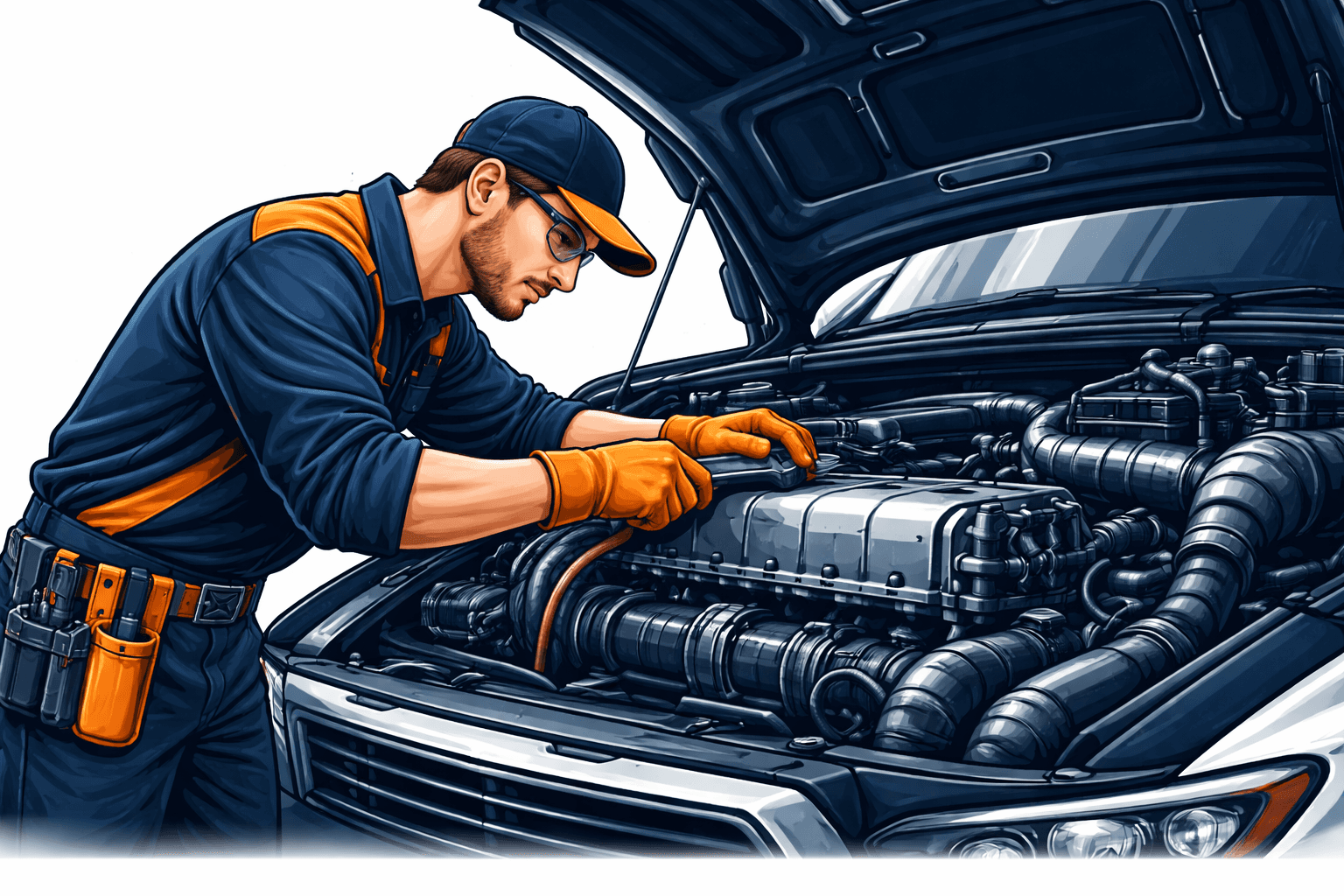
Why You Should Be Checking Your Own Fluids
Here is the truth. Learning how to check your own fluids is the number one thing you can do to save money on car repairs.
I'm not saying this to sell you anything. I'm saying it because after two and a half decades in the shop, I've watched countless engines, transmissions, and brake systems die because someone never popped the hood between oil changes. A two-minute oil check would have caught the leak. A quick glance at the coolant reservoir would have shown it was empty. A look at the brake fluid would have revealed it was black as coffee.
You don't need tools. You don't need experience. You just need 10 minutes, a rag, and this guide. Let's go through every fluid in your car - what it does, where to find it, how to check it, and what bad fluid looks like so you know when something's wrong.
Engine Oil - How to Check It Properly
Engine oil is the lifeblood of your motor. It lubricates moving parts, cools internal components, cleans deposits, and prevents metal-on-metal wear. Run an engine low on oil and you're looking at bearing damage, spun bearings, or a seized engine - all of which mean "new engine" in most cases. That's a $4,000-$10,000 repair.
Hot vs. Cold - When to Check
This is one of the most common questions I get: should you check oil hot or cold?
Cold check (engine off, sitting overnight): Oil has fully drained back into the oil pan. The reading will be slightly higher than a warm reading. This is fine for a quick level check.
Warm check (drive 5-10 minutes, shut off, wait 2-3 minutes): This is the more accurate method, and it's what most manufacturer procedures call for. The oil is at operating temperature and has had a moment to settle. Most dipsticks are calibrated for a warm check.
Either way works for a basic "am I low?" check. Just be consistent - always check the same way so you can spot trends.
Step-by-Step: How to Check Engine Oil
- Park on a level surface. A sloped driveway will give you a false reading - the oil pools to one side of the pan.
- Open the hood and find the dipstick. It usually has a yellow, orange, or bright-colored handle. On inline-four engines, it's typically on the front or side of the engine block. On V6/V8 engines, it can be on either side. If you drive a BMW, most Mercedes, some Audis, or a newer Ford with the 2.7L or 3.5L EcoBoost - you might not have a dipstick at all. These vehicles check oil level electronically through the instrument cluster. Check your owner's manual.
- Pull, wipe, reinsert, pull again. Pull the dipstick out, wipe it clean with a lint-free rag or paper towel, push it all the way back in, then pull it out again. That second pull gives you the real reading.
- Read the level. Look at where the oil film ends on the dipstick. There are two marks - they might be dots, lines, hash marks, or letters (L/H or MIN/MAX). The oil should be between them. The space between low and high typically represents about one quart.
- Check the condition. Rub the oil between your thumb and forefinger. Good oil is smooth and amber to light brown. Bad oil is gritty and very dark. Milky, frothy oil is a red flag - that's coolant contamination, often from a blown head gasket.
Adding Oil
If you're low, add the correct weight oil in half-quart increments. The correct weight is printed on your oil cap or in your owner's manual. Common weights are 0W-20 (most newer Hondas, Toyotas, Hyundais), 5W-20 (many Fords, some GMs), and 5W-30 (older vehicles, many trucks). Add half a quart, wait a minute, re-check. Don't overfill - too much oil causes aeration (foaming), which reduces lubrication and can blow out seals. I've seen overfilled engines blow rear main seals because the crankshaft was essentially whipping the oil into a froth.
Transmission Fluid - Check Procedure and Color Guide
Transmission fluid lubricates gears, acts as hydraulic fluid for shifting, and cools the transmission. Low or burnt fluid is a death sentence for your transmission - and a transmission replacement runs $3,000-$7,000 depending on the vehicle.
Does Your Car Have a Transmission Dipstick?
This is important: many newer cars don't have a consumer-accessible transmission dipstick. If you drive a 2012+ BMW, most Mercedes-Benz models, a 2015+ Honda (CR-V, Civic with CVT), a 2017+ Ford F-150 with the 10R80 transmission, or many newer Hyundai/Kia models with CVTs - your transmission is "sealed." Checking the fluid requires lifting the car, removing a fill plug, and checking at a specific operating temperature. That's a shop job.
If your car does have a transmission dipstick, it's usually located further back on the engine (toward the firewall) and has a red or pink handle. Don't confuse it with the engine oil dipstick.
How to Check Automatic Transmission Fluid
- Warm up the transmission. Drive the car for 10-15 minutes in normal driving conditions. The fluid needs to be at operating temperature for an accurate reading.
- Park on level ground, leave the engine running. This is different from engine oil - most automatic transmissions are checked with the engine idling in Park. (Some Hondas are checked with the engine off - check your manual.)
- Cycle through the gears. With your foot on the brake, shift from Park through each gear (R, N, D, L) and hold for 2-3 seconds in each, then return to Park. This fills all the circuits.
- Pull, wipe, reinsert, pull. Same technique as the oil dipstick. Read the "HOT" marks (there are usually both "COLD" and "HOT" markings).
- Inspect the color and smell. This is the big one.
Transmission Fluid Color Guide
| Color | Condition | What It Means |
|---|---|---|
| Bright pink / red | New / good | Fluid is fresh and functioning properly. No action needed. |
| Light brown / dark red | Normal wear | Fluid has some age on it but is still functional. Plan to service within the next 15,000 miles. |
| Dark brown | Overdue | Fluid has significant wear. Service soon - change the fluid and filter. |
| Black / very dark brown | Burnt | Fluid is burnt. Smells like burnt toast. Internal damage may already be occurring. Get a professional inspection immediately. |
| Pink and milky | Contaminated | Coolant has mixed with the transmission fluid (often a failed transmission cooler inside the radiator). Major issue - needs immediate repair. |
Coolant / Antifreeze - The One That Can Burn You
Coolant keeps your engine from overheating in summer and from freezing in winter. It circulates through the engine block, radiator, heater core, and on many vehicles, through the transmission cooler and turbo (if equipped). Low coolant means your engine is at risk of catastrophic overheating - and overheating kills engines faster than just about anything.
How to Check Coolant
- Wait for the engine to cool. At least 30-60 minutes after driving, or better yet, check it first thing in the morning when the engine is cold.
- Find the coolant reservoir. It's a translucent plastic tank connected to the radiator by a small hose. It's usually marked with MIN and MAX lines and may be labeled "coolant" or have a warning symbol on the cap. On most modern cars, you can check the level without even opening the cap - just look at the side of the reservoir.
- Check the level. With a cold engine, the coolant should be at or near the "COLD" or "MIN" line. If the engine is warm (but safe to open), it should be closer to the "HOT" or "MAX" line. If you can't see fluid at all, you're dangerously low.
- Check the condition. Coolant should be its original color - green, orange, pink, or blue depending on the type. If it's rusty, brown, has particles floating in it, or looks like chocolate milk (oil contamination), there's a problem.
Coolant Types - They're Not All the Same
There are three main types of coolant, and mixing the wrong ones can cause gel formation and cooling system blockages:
- Green (IAT - Inorganic Additive Technology): Traditional coolant. Found in most older vehicles (pre-2000). Change every 2 years or 30,000 miles.
- Orange (OAT - Organic Acid Technology): Used by GM (Dex-Cool), some VW/Audi, and others. Longer life - typically 5 years or 150,000 miles. Do not mix with green.
- Pink/Blue/Purple (HOAT - Hybrid OAT): Used by many Asian and European manufacturers. Toyota uses pink. Honda uses blue. These are long-life formulas. Check the manufacturer's owner portal for your specific vehicle.
When in doubt, check your owner's manual. If you're topping off, use the same type that's already in the system. Universal coolants exist, but I'm not a fan of them - use the right stuff.
Brake Fluid - DOT Types and What to Watch For
Brake fluid transmits the force from your foot on the pedal to the brake calipers at each wheel. If this fluid is low, contaminated, or old, your braking performance degrades - and brakes are not something you want performing at 80%. According to NHTSA, brake-related issues are a factor in a significant number of vehicle accidents each year.
How to Check Brake Fluid
- Find the brake fluid reservoir. It's on the driver's side of the engine bay, mounted on top of the brake master cylinder (a metal cylinder attached to the firewall, right in front of the brake pedal on the other side). The reservoir is translucent plastic with MIN and MAX lines.
- Check the level without opening it. You can usually see the fluid level through the plastic. It should be between MIN and MAX. If it's at or below MIN, you have a problem - either your brake pads are worn (as pads wear, more fluid stays in the calipers, lowering the reservoir level) or you have a leak somewhere.
- If you open it, check the color. Fresh brake fluid is clear to light yellow, like cooking oil. Old brake fluid turns dark amber to brown. If it's very dark, it's absorbed a lot of moisture and should be flushed.
DOT Ratings - What They Mean
The DOT number on your brake fluid refers to its federal specification and tells you its boiling point:
- DOT 3: Dry boiling point of 401 degrees F. Standard for most older and economy vehicles. Absorbs moisture over time, which lowers the boiling point.
- DOT 4: Dry boiling point of 446 degrees F. Used in most European cars, newer trucks, and performance vehicles. Higher boiling point = better fade resistance. DOT 4 is backward-compatible with DOT 3 systems.
- DOT 5: Silicone-based. Purple colored. Do NOT mix with DOT 3 or DOT 4. Used almost exclusively in military vehicles and classic cars. If someone puts DOT 5 in a DOT 3/4 system, it causes seal swelling and brake failure.
- DOT 5.1: Not the same as DOT 5. This is glycol-based (like DOT 3/4) but with a higher boiling point. Compatible with DOT 3/4 systems. Used in some performance and motorcycle applications.
Power Steering Fluid
Power steering fluid makes your steering wheel easy to turn by providing hydraulic pressure to the power steering pump and rack. Not all cars have it - many modern vehicles use electric power steering (EPS) with no fluid at all. This includes most Toyotas and Hondas built after 2012, Chevy Cruzes, Ford Fusions, and most electric/hybrid vehicles. If your car has electric steering, skip this section - there's no fluid to check.
How to Check Power Steering Fluid
- Find the reservoir. If your vehicle has hydraulic power steering, the reservoir is usually a small plastic or metal container near the serpentine belt on the driver's side. It may have a cap with a built-in dipstick, or it may be a translucent reservoir with MIN/MAX lines.
- Check when cold or warm. Many power steering dipsticks have both COLD and HOT markings. Use the appropriate one.
- Inspect the fluid. Fresh power steering fluid is usually clear, light red, or light amber. Dark brown or black fluid is old and should be replaced. If you see foam or bubbles in the fluid, there may be a leak in the system allowing air in - you'll usually hear a whining noise when turning the wheel.
If your power steering fluid is consistently low, look for leaks at the pump, the rack-and-pinion seals, or the high-pressure hose connections. Power steering leaks tend to get worse, not better. On GM trucks and SUVs (2000-2010 Silverados, Tahoes, Yukons), leaking power steering hoses at the cooler lines are extremely common. On Hondas, the pump itself tends to leak from the rear seal.
Windshield Washer Fluid
Okay, this one won't kill your engine. But it can get you killed if you can't see. I've driven behind trucks on a slushy highway with an empty washer fluid tank and it's about as fun as driving blindfolded.
How to Check and Fill
- Find the reservoir. It has a cap with a windshield/water symbol on it. It's usually blue.
- Look inside or check the level lines. If you can't see fluid, it's time to fill.
- Fill with washer fluid - not water. In winter, water freezes and cracks the reservoir. Washer fluid is rated for sub-zero temps. In summer, it has detergents that cut through bug splatter and road film. It costs about $3 a gallon. Use it.
That's it. This is the easiest fluid check on the car. No excuses for letting it go empty.
Fluid Condition Quick Reference Chart
| Fluid | Good Condition | Needs Attention | Immediate Concern |
|---|---|---|---|
| Engine Oil | Amber to light brown, smooth | Dark brown/black, still smooth | Gritty, milky, frothy, or metallic sheen |
| Transmission Fluid (ATF) | Bright pink/red, no smell | Light brown, slight odor | Dark brown/black, burnt smell, or milky pink |
| Coolant | Clear green, orange, pink, or blue (type-specific) | Slightly faded color, still clear | Rusty, brown, oily film, particles, or chocolate-milk appearance |
| Brake Fluid | Clear to light yellow | Amber/darkening | Dark brown/black, or gritty debris |
| Power Steering Fluid | Clear, light red, or light amber | Darkening, slight discoloration | Black, foamy, or smells burnt |
| Washer Fluid | Any color - it's there | Getting low | Empty (fill it up, come on) |
How Shops Upsell on Fluid Services
I'm a shop guy, and I'm going to tell you straight - some shops use fluid services as easy upsells. Here's what to watch for:
- "Your brake fluid tested at 3% moisture - you need a flush." Those brake fluid test strips change color in about 2 seconds and are about as accurate as a horoscope. Some shops use them to justify a $200 flush on fluid that's perfectly fine. A real test uses a refractometer or boiling point tester. If they can't tell you the actual boiling point, they're guessing.
- "Your coolant tested acidic - you need a flush." Coolant does become acidic over time, and the pH strips they use are more reliable than brake fluid strips. But if your coolant is under 3 years old and the correct type - you're probably fine. Ask for the actual pH reading.
- "Your transmission fluid is dark - you need a flush." Transmission fluid does darken with use, and yes, it should eventually be serviced. But a "transmission flush" using a machine that forces new fluid through the system can actually dislodge debris and cause problems in a high-mileage transmission that's never been serviced. I prefer a drain-and-fill (drop the pan, replace the filter, refill) over a power flush any day. Two or three drain-and-fills spaced 5,000 miles apart will exchange about 90% of the fluid safely.
- "Your power steering fluid is dirty - you need our $150 flush." Power steering fluid does wear out, but a "flush" is often just sucking out the old fluid from the reservoir with a turkey baster and putting in new fluid. You can do this at home for $8. If the shop is charging $150, they'd better be flushing the entire system including the rack.
I'm not saying these services are never needed. They are. I'm saying know what you're being sold and why. Check your fluids regularly so you know what condition they're in before a shop tells you. Knowledge is leverage.
For techs who want to go deeper into vehicle systems, I also built step-by-step diagnostic guides that cover every system on the car - from cooling to electrical to drivetrain. Same real-world approach, based on what we actually see fail in the shop.
Your Monthly Fluid Check Routine
Here's what I recommend. Once a month - or before any road trip - do a full fluid check. It takes 10 minutes. Here's the order I use:
- Engine oil - check level and condition
- Coolant - check reservoir level (engine cold)
- Brake fluid - check level through reservoir
- Power steering fluid - check level (if applicable)
- Transmission fluid - check level and color (if accessible)
- Washer fluid - top off
Keep a small notebook in your glove box or a note on your phone. Write down dates and any observations. "April 29 - oil level good, coolant full, brake fluid slightly dark." That way, if something starts dropping, you catch the trend early. A slow oil leak that takes a quart every 2,000 miles is manageable. But if you're not checking, that slow leak becomes a dry engine on the highway.
The National Highway Traffic Safety Administration (NHTSA) recommends regular fluid checks as part of basic vehicle maintenance for safety. It's free, it's fast, and it could save your engine - or your life in the case of brake fluid.
Final Word
You don't need to be a mechanic to check your car's fluids. You just need to pop the hood, know where to look, and know what you're looking at. Everything in this guide takes 10 minutes. The first time might take 20 while you figure out which cap is which - and that's fine. By the third time, you'll have it down cold.
Your car is a machine. Machines need fluids. Check them. It's the cheapest insurance you'll ever get.
For more on how often to service these fluids once you know their condition, check the manufacturer's maintenance schedule in your owner's manual, or see the recommended intervals from ASE (National Institute for Automotive Service Excellence).