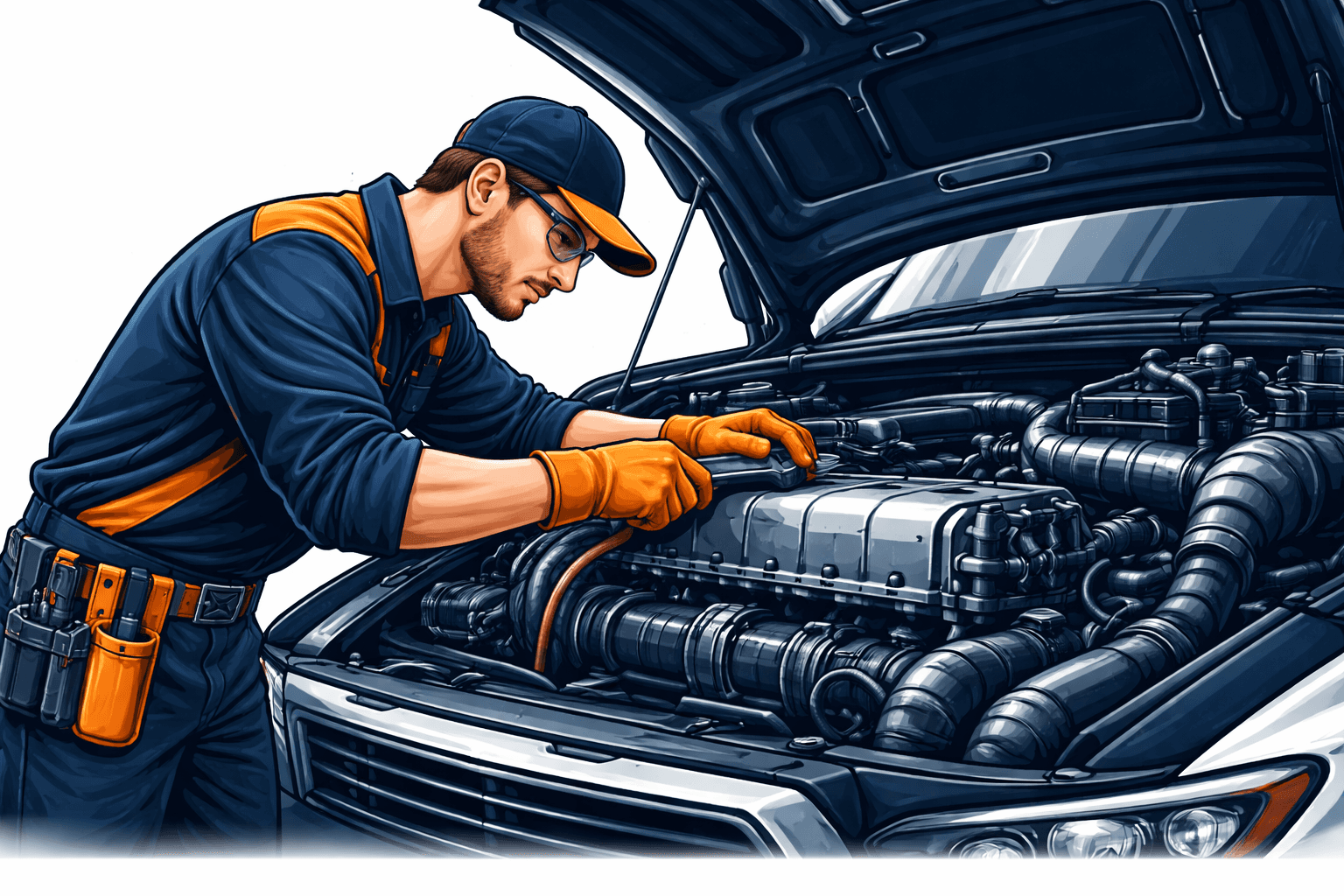
I've replaced more timing belts than I can count, and I've also rebuilt engines that were destroyed because the belt broke before the owner got around to replacing it. One of those repairs costs $500-$1,200. The other costs $3,000-$6,000+. I'll let you guess which one I'd rather see you pay for.
The timing belt is one of those maintenance items that doesn't give you much warning before it fails. It's not like brake pads that squeal or tires that show wear. A timing belt can look fine one minute and snap the next. That's why it's a mileage-based replacement - you do it on schedule whether it looks worn or not.
What the Timing Belt Actually Does
Your engine is a precisely timed machine. Pistons go up and down in the cylinders, and valves open and close at the top of those cylinders to let air and fuel in and exhaust out. The timing belt connects the crankshaft (which controls the pistons) to the camshaft(s) (which control the valves). It keeps them perfectly synchronized so that valves are open when the piston is down and closed when the piston comes up to compress the fuel mixture.
This synchronization has to be exact - we're talking about thousandths of a second at engine speed. The belt has teeth that mesh with gears on the crankshaft and camshaft(s) to maintain this precise timing. On a DOHC (dual overhead cam) engine, there are two camshaft gears per bank, which means the belt is doing even more work.
The belt also typically drives the water pump. This is a key detail that factors into your replacement cost - more on that in a moment.
Interference vs. Non-Interference Engines
This is the single most important thing to understand about timing belts. It determines whether a broken belt is a major inconvenience or a catastrophic engine failure.
Interference engine: The pistons and valves occupy the same space in the cylinder at different times. If the timing belt breaks, the pistons and valves collide. Valves bend, pistons can crack, and the cylinder head is often damaged. This turns a $500-$1,200 belt replacement into a $3,000-$6,000+ engine repair or replacement. The vast majority of modern engines are interference designs.
Non-interference engine: The pistons and valves are designed with enough clearance that they never occupy the same space, even if timing is lost. If the belt breaks, the engine stops running but no internal damage occurs. Replace the belt and you're back on the road. These are less common in modern vehicles but some exist.
How do you know which type you have? Check your owner's manual, ask your mechanic, or look it up by engine code. Do not assume. I've seen people assume they had a non-interference engine, neglect the belt, and get a very expensive education.
When to Replace Your Timing Belt
Most manufacturers recommend timing belt replacement between 60,000 and 100,000 miles, or between 5 and 10 years - whichever comes first. The time-based interval matters because rubber deteriorates with age regardless of mileage. A car that's been sitting in a garage for 8 years with 30,000 miles still needs the belt replaced.
Common manufacturer intervals:
- Honda/Acura: 60,000 - 105,000 miles depending on model and year
- Toyota/Lexus: 60,000 - 90,000 miles (many newer Toyotas use timing chains)
- Subaru: 105,000 miles (most models)
- Hyundai/Kia: 60,000 miles (older models - many newer ones use chains)
- Volkswagen/Audi: Varies widely - some as low as 60,000 miles
- Mitsubishi: 60,000 miles on many models
Check your owner's manual for the exact interval for your specific vehicle. If you bought the car used and don't know when the belt was last replaced, err on the side of replacing it. The cost of a new belt is nothing compared to the cost of a destroyed engine. Following a proper car maintenance schedule keeps you on track for replacements like this.
Warning Signs of a Failing Timing Belt
Here's the frustrating truth: timing belts often give little to no warning before they fail. But there are a few signs to watch for:
- Ticking noise from the engine: A worn timing belt can create a ticking or clicking sound as the teeth begin to wear. This is not always present, but if you hear it along with other symptoms, pay attention.
- Engine won't start or cranks but won't fire: If the belt has broken, the engine will crank freely (actually faster than normal because there's no compression) but won't start. There's no way for the valves to open and close without the timing belt.
- Visible wear on the belt: If your mechanic has the cover off for any reason, the belt can be visually inspected. Cracks, fraying, missing teeth, or glazing all indicate it's time to replace.
- Oil leak near the timing cover: Oil leaking from the front of the engine can contaminate the timing belt, accelerating its deterioration. If you have a front crankshaft seal leak, get it fixed and replace the belt at the same time since you're already in there.
- Mileage or age: The most reliable "warning sign" is your odometer. If you're at or past the recommended interval, don't wait for symptoms. Replace it.
Timing Belt Replacement Cost Breakdown
| Component | Parts Cost | Notes |
|---|---|---|
| Timing Belt | $30 - $100 | The belt itself is surprisingly affordable |
| Tensioner(s) | $30 - $100 | Always replace with the belt |
| Idler Pulley(s) | $15 - $50 each | Keeps belt tracking straight - replace them |
| Water Pump | $40 - $150 | Strongly recommended - see below |
| Front Crankshaft Seal | $10 - $30 | Replace while you're in there |
| Camshaft Seal(s) | $10 - $25 each | Replace while you're in there |
| Labor | $300 - $700 | 3-6 hours depending on vehicle |
Total typical cost: $500 - $1,200 for the complete job including belt, tensioner, idler pulleys, water pump, and seals. Dealerships tend to be on the higher end. Independent shops with experience on your make are usually more affordable.
Some vehicles are significantly more expensive. Audi and Volkswagen models with the 1.8T and 2.0T engines, for example, can run $800-$1,500+ due to the complexity of the job. Subaru boxers require more access work. V6 models with transverse-mounted engines (like a Honda Accord V6) have less working room and cost more than their four-cylinder counterparts.
Why You Should Replace the Water Pump Too
On most timing belt engines, the water pump is driven by the timing belt and located behind the timing cover. That means to replace the water pump, you'd need to remove the timing belt anyway - and the labor is the same.
Here's the math: if you replace only the timing belt now ($500-$1,200) and the water pump fails in 20,000 miles, you'll pay another $500-$1,200 in labor to take everything apart again, plus the $40-$150 water pump. You're essentially paying for the same labor twice.
Replace the water pump with the timing belt. Every time. The water pump adds maybe $40-$150 in parts but zero additional labor. It's the single best value-add in automotive maintenance. I won't do a timing belt without replacing the water pump, and any technician worth their tools will tell you the same thing. For more context on cooling system maintenance, check out our coolant leak guide.
Timing Belt vs. Timing Chain
Not all engines use timing belts. Many use timing chains instead. Here's the difference:
Timing Belt: Made of reinforced rubber with teeth. Quieter operation. Requires scheduled replacement (60,000-100,000 miles). Less expensive to replace when done on schedule.
Timing Chain: Made of metal links, similar to a bicycle chain. Louder but more durable. Designed to last the life of the engine in most cases. No scheduled replacement interval. When they do fail, they're more expensive to replace because of the metal components and guides involved.
How to know which your vehicle has: check the owner's manual, look it up by engine code, or ask a mechanic. As a general rule, most modern vehicles (2010+) from domestic and Asian manufacturers have moved toward timing chains. But many popular vehicles still use belts, especially certain Honda, Subaru, and older Hyundai/Kia models.
Timing chains can and do fail - usually the chain stretches, the tensioner fails, or the guides break. When they do, the symptoms are a rattling noise on startup and a check engine light for timing correlation. But this is typically at much higher mileage than a timing belt failure, often 150,000+ miles.
What Happens If Your Timing Belt Breaks
Let me paint the picture so you understand the stakes:
Interference engine: The belt snaps. The camshaft(s) stop turning immediately. The valves freeze in whatever position they were in - some open, some closed. The crankshaft, driven by the momentum of the car and the flywheel, keeps spinning. Pistons slam into open valves. Valves bend like paperclips. Piston tops can crack. The cylinder head sustains damage. Your engine goes from running fine to internally destroyed in less than one second. You hear a loud bang or clattering noise, and the engine dies.
Repair cost: valve job ($1,500-$2,500), or if piston damage is involved, engine replacement ($3,000-$7,000+ including labor). On many vehicles, this exceeds the car's value.
Non-interference engine: The belt snaps. The engine dies. You coast to the side of the road. Nothing is damaged internally. You get it towed to a shop, they replace the belt, and you drive away. Annoyance level: high. Damage level: zero.
See why knowing which type of engine you have matters? If you have an interference engine, the timing belt is not optional maintenance. It's insurance against a catastrophic failure.
How to Save Money on This Repair
- Go to an independent shop, not the dealer. Dealerships charge a premium for this job. An independent shop with experience on your make will do the same quality work for less. Check reviews and ask if they specialize in your brand.
- Buy the complete kit, not just the belt. Timing belt kits include the belt, tensioner, idler pulleys, and sometimes the water pump. Buying the kit is cheaper than buying components separately, and it ensures everything is the same brand and quality.
- Do it on schedule, not after it breaks. A scheduled replacement: $500-$1,200. An emergency repair after the belt breaks on an interference engine: $3,000-$7,000+. The cheapest timing belt replacement is the one done on time.
- Combine it with other maintenance. If you're due for a timing belt and also need front seals, a coolant flush, or accessory belt replacement, doing them together saves labor because much of the disassembly overlaps. For a deeper dive into these decisions, browse the technical guides at APEX Tech Nation.