How to Describe Your Car Problem to a Mechanic
Before we talk about what car repair costs or how to spot a bad shop, let's start at the beginning: getting a good diagnosis starts with how you describe the problem.
I cannot tell you how many hours I have wasted chasing a noise that the customer called "a rattle" that turned out to be a squeak, or a "grinding when I turn" that only happened when backing out of a driveway at a specific angle. The more specific you are, the faster we find the problem - and the less you pay in diagnostic labor.
Here is what a good problem description sounds like:
- What does it do? Grinding, clicking, shaking, stalling, hesitating, pulling, squealing, smoking, leaking.
- When does it happen? Cold starts only, highway speeds, turning left, braking hard, after 20 minutes of driving, all the time.
- How long has it been going on? Two days, three weeks, six months.
- Is it getting worse, staying the same, or intermittent? Intermittent problems are the hardest to diagnose - the more detail you provide, the better.
- Any warning lights on? Tell the tech exactly which light. "A light came on" is not enough. "The check engine light came on yesterday and the car is running a little rough" is.
- Did anything happen before it started? You hit a pothole, it rained heavily, you just had an oil change, you filled up with a different gas brand.
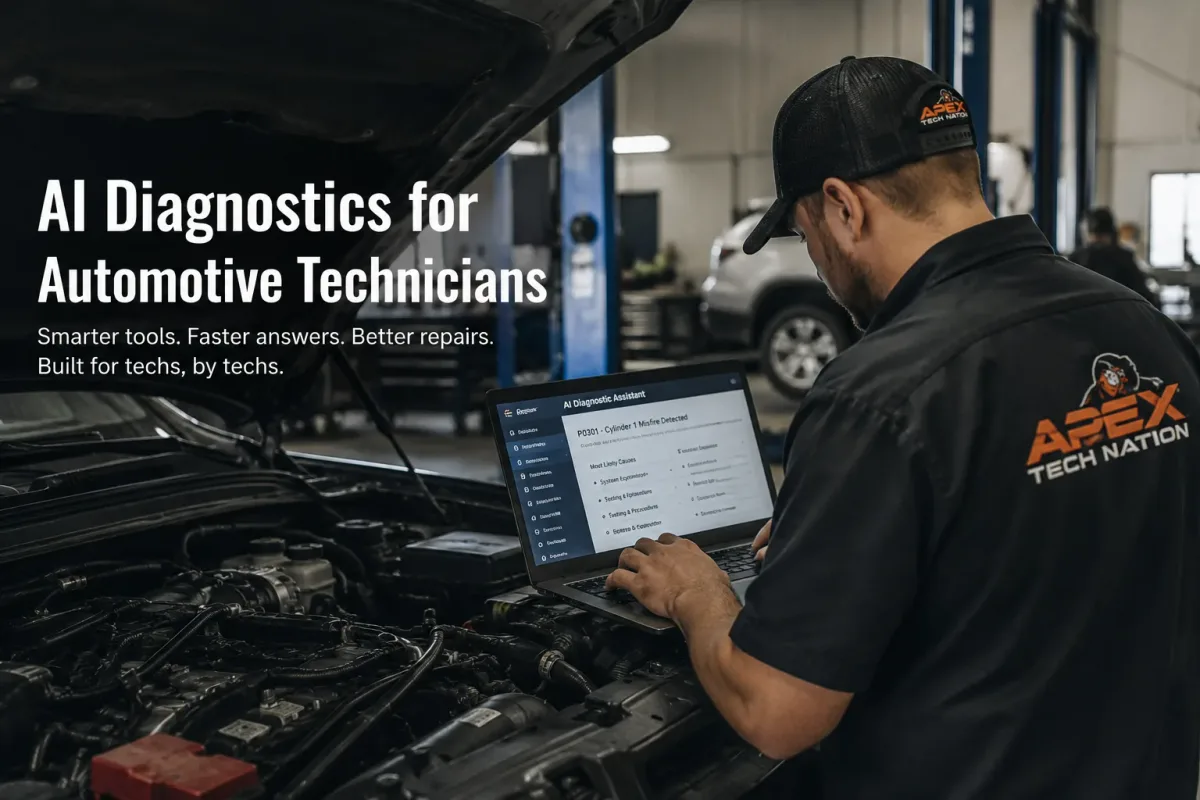
And if you want to understand what might be wrong before you even step into a shop - the AI diagnostic tools for professional technicians at APEX Tech Nation use the same symptom-based diagnostic flow I use in the bay. It will not replace a physical inspection, but it will help you walk into the shop knowing what questions to ask.
Types of Repair Shops: Dealer vs. Independent vs. Chain
Not all repair shops are the same. Understanding the difference matters for your wallet and your vehicle.
Dealership Service Department
Factory-trained technicians. OEM parts. Proprietary scan tools. Access to technical service bulletins (TSBs) and recall information before they hit the public. If your car is under warranty, the dealer is where you want to be - warranty work is paid by the manufacturer, not you. For complex electronic issues, programming, or anything requiring factory-level access, the dealer is often the right call.
Downside: Higher labor rates ($120-$200/hr in most markets), and the service advisor is incentivized to sell additional services. Common repairs like brakes or batteries will almost always cost more at a dealer than a reputable independent shop.
Independent Shop
An independently owned repair shop, often run by a technician or small business owner. This is where most of the best mechanics in the country work. A good independent shop will have ASE-certified techs, professional scan tools, and the experience to handle most repairs on most vehicles.
Advantage: Lower labor rates ($90-$150/hr typically), more flexibility on parts choices, and you often deal directly with the person working on your car. A shop that has been in business for 15+ years in the same location has built a reputation - that means something.
Downside: Quality varies widely. A bad independent shop is worse than a bad chain shop because there is less accountability. Check reviews, ask for ASE certifications, and look for AAA-approved facilities if you are unsure.
Chain/Franchise Shops
National brands like Firestone, Midas, Jiffy Lube, Pep Boys, and similar. Convenient locations, consistent processes, and national warranties on parts and labor. Good for routine maintenance - oil changes, tire rotations, battery replacements.
Downside: Chain shops employ technicians of varying skill levels. Complex diagnostic work is often not their strong suit. Some chains have a documented history of recommending unnecessary services. Stick to what they are good at: routine, straightforward jobs.
Specialty Shops
Shops that focus on a specific system or brand - transmission shops, tire shops, alignment specialists, European car specialists, diesel shops. If you need a transmission rebuilt or you drive a BMW, a specialist often provides better quality and value than a general shop.
Cost Comparison by Shop Type
These are 2026 national averages. Costs vary by region - expect to pay more in major metro areas and less in rural markets.
| Repair | Dealership | Independent | Chain |
|---|---|---|---|
| Brake pad replacement (front) | $300–$500 | $180–$320 | $200–$380 |
| Alternator replacement | $600–$1,000 | $350–$650 | $400–$700 |
| Starter replacement | $450–$800 | $250–$550 | $300–$600 |
| Water pump replacement | $500–$1,000 | $300–$700 | $350–$750 |
| Battery replacement | $200–$400 | $150–$280 | $150–$300 |
| Tire rotation + balance | $60–$120 | $40–$80 | $30–$70 |
| Oil change (full synthetic) | $80–$160 | $60–$110 | $60–$100 |
| Diagnostic scan | $150–$200 | $75–$150 | $0–$100 |
Note on dealer costs: Dealers use a flat-rate labor system based on manufacturer published times. A job that takes a flat-rate tech 45 minutes but is booked at 1.5 hours gets billed at 1.5 hours regardless. This is standard across the industry, not dealer-specific - but dealer hourly rates are higher, so the math adds up faster.
How to Read a Repair Estimate
Before any auto repair begins, you should receive a written estimate. Here is what to look for and what every line means.
Parts
Each part should be listed by name, part number (or "aftermarket equivalent"), and price. Ask whether the parts are OEM (original equipment manufacturer), OEM-equivalent aftermarket, or economy grade. For critical safety components - brakes, wheel bearings, steering parts - I recommend OEM or quality aftermarket (Bosch, AC Delco, Motorcraft, Denso). Economy parts on safety systems are not worth the savings.
Labor
Labor is listed in hours. The estimate will show hours × the shop's hourly rate. A legitimate shop will tell you their hourly rate upfront. Labor hours come from a flat-rate guide (Mitchell, AllData, Chilton). Some overlap is normal - a skilled tech may finish faster, but you are billed the guide time, not actual time.
Shop Fees and Supplies
Most shops charge a shop supply fee - typically 5-10% of the labor total, usually capped around $25-$50. This covers rags, solvents, small fasteners, and consumables. It is a legitimate charge. You may also see a hazardous waste fee for disposing of old fluids and parts. These are normal.
What Is NOT Normal
- Vague line items like "miscellaneous" or "additional labor" without explanation
- Parts with no description or part number
- Labor hours that seem excessive (check the flat-rate time for your specific repair online)
- Fees you were not told about upfront
Red Flags: When a Shop Is Ripping You Off
Here are the clearest warning signs of a bad shop.
- Pressure to authorize work immediately. "If you don't fix this today, your engine will seize" is almost always manipulation. Real emergencies exist, but a trustworthy shop will explain the actual risk level and let you make an informed decision.
- Refusal to give a written estimate. This is illegal in most states. Never authorize repairs without a written estimate in hand.
- They cannot show you the failed part. If they replaced something, the old part should be available for you to see. Exceptions: core exchange items (starters, alternators on a core deposit) where the old unit goes back to the supplier. But they should be able to explain this.
- New problems discovered on every visit. One or two additional findings over time is normal. Finding five new problems every single visit is not.
- Vague diagnosis. "Your transmission is slipping" with no codes, no inspection, and a quote for a full rebuild is a red flag. A proper diagnosis identifies specific components, not just a system.
- They recommend services not in your owner's manual. Fuel injection cleaning, transmission flushes, cooling system flushes - some of these are legitimate, but if your manufacturer doesn't recommend them at your mileage, question why the shop does.
- They deny you the right to see the vehicle on the lift. Reputable shops let you see what they are pointing at. If a shop refuses to show you the problem, find a different shop.
Your Rights as a Consumer
Most drivers do not know they have legal rights when it comes to auto repair. These vary by state, but here are the protections that exist in most of the country.
Written Estimate
In most states, any repair estimated at over $100 requires a written estimate before work begins. The final bill generally cannot exceed the estimate by more than 10% without your prior written or documented verbal authorization.
Right to Your Old Parts
You can request your old parts back before the repair begins. Put it in writing on the repair order. The exception is warranty-exchange or "core" parts - when a rebuilt alternator or starter is installed, the old unit has to go back to the remanufacturer as part of the exchange. The shop should explain this if it applies.
Right to a Second Opinion
You have the right to take your vehicle and your diagnosis to another shop before authorizing work. A shop may charge you a diagnostic fee for their time, but you own the vehicle and the decision is yours. Some shops try to hold vehicles as "collateral" for diagnostic fees - know your state's laws on this.
Warranty on Repairs
Most reputable shops warranty their parts and labor for at least 12 months / 12,000 miles. Get the warranty terms in writing. If a part fails within the warranty period, the shop should repair it at no additional charge.
Itemized Bill
You are entitled to an itemized invoice that shows exactly what was done, what parts were used, and what each item costs. "Labor: $500" with no further detail is not an acceptable invoice.
Complaint Options
If you believe a shop acted in bad faith, you can file a complaint with your state's Bureau of Automotive Repair (or equivalent), the Better Business Bureau, and your state's Attorney General consumer protection division. If you paid by credit card and the shop refuses to address a legitimate complaint, you may have chargeback options through your card issuer.
When to Get a Second Opinion
Second opinions are not just for medical diagnoses. Here is when you should always get one before authorizing an auto repair:
- The repair estimate is over $500
- The recommended repair involves the engine, transmission, or major suspension components
- You were not shown the failed part or given specific diagnostic codes
- The shop is pressuring you to decide immediately
- The diagnosis does not match the symptoms you described
- The shop recommends replacing multiple components at once without a clear explanation of why each one is needed
- You have a gut feeling something is off
A second diagnostic fee ($75-$150) is almost always worth paying before a $1,500+ repair. It either confirms the first shop's diagnosis - which gives you confidence - or it reveals a different problem, which saves you money. Either outcome is a win.
When getting a second opinion, do not tell the second shop what the first shop said. Let them diagnose it fresh. Then compare. If both shops agree, you have confidence. If they disagree significantly, a third opinion may be warranted.
Common Repairs and What They Should Cost
These are realistic cost ranges for 2026 at an independent or chain shop on a mainstream vehicle (Toyota, Honda, Ford, Chevrolet, Nissan). Luxury vehicles and high-performance cars add 30-60%.
| Repair | Parts | Labor | Total Range |
|---|---|---|---|
| Front brake pads + rotors | $80–$200 | $100–$200 | $180–$400 |
| Rear brake pads + rotors | $80–$200 | $100–$200 | $180–$400 |
| Full brake job (all four) | $200–$450 | $200–$350 | $400–$800 |
| Alternator replacement | $150–$350 | $100–$300 | $350–$650 |
| Starter replacement | $100–$300 | $100–$250 | $250–$550 |
| Water pump replacement | $100–$250 | $200–$500 | $300–$750 |
| Serpentine belt | $25–$80 | $75–$150 | $100–$230 |
| Thermostat replacement | $20–$80 | $75–$200 | $100–$280 |
| Spark plugs (4-cyl) | $30–$80 | $75–$150 | $100–$230 |
| Spark plugs (V6/V8) | $50–$150 | $150–$350 | $200–$500 |
| Wheel bearing (one side) | $100–$250 | $150–$300 | $250–$550 |
| CV axle replacement | $80–$200 | $100–$250 | $180–$450 |
| Oxygen sensor | $50–$150 | $75–$150 | $125–$300 |
| Mass air flow sensor | $80–$200 | $50–$100 | $130–$300 |
| Catalytic converter | $400–$1,200 | $150–$300 | $550–$1,500 |
Why labor costs vary so much: The same repair can take 45 minutes on a Honda Civic and three hours on a Chevy Traverse. Access to the part, the number of components that have to come off first, and whether any fasteners are rusted or stripped all affect labor time. A fair shop will explain why a specific job takes longer on your specific vehicle.
When the Bill Seems High
Before assuming you are being overcharged, check the flat-rate labor time for your specific repair on your specific vehicle at your model year. Sites like RepairPal, NAPA AutoCare, and Mitchell 1's DIY portal publish estimated ranges. If the shop's hours are significantly over the published flat rate, ask them to explain.
DIY vs. Shop Decision Guide
I am not anti-DIY. I respect anyone who wants to learn. But I have also seen DIY repairs that turned a $200 job into a $1,500 job. Here is how to decide honestly.
Good DIY Candidates
- Air filter and cabin air filter replacement
- Windshield wiper blades
- Battery replacement (most vehicles)
- Light bulbs (exterior, where accessible)
- Oil change (if you are comfortable and have the right tools)
- Basic tire inflation and pressure checks
DIY with Caution - Do Your Research First
- Brake pad replacement (straightforward, but brake safety is non-negotiable - do it right or don't do it)
- Spark plug replacement (easy on 4-cylinders, difficult on V6s with rear-bank plugs)
- Serpentine belt (manageable, but routing diagrams are critical)
- Thermostat (simple on most engines, complex on others)
Leave It to the Shop
- Anything requiring dealer-level programming (keys, modules, fuel injectors on some vehicles)
- ABS module, airbag components, or any safety-critical electronics
- Transmission internal work
- Engine removal and teardown
- Anything on a vehicle you depend on daily where a mistake has serious consequences
Frequently Asked Questions
How do I describe a car problem to a mechanic?
Be specific about when it happens, under what conditions, how long it has been going on, and whether it is getting worse. "It makes a grinding noise when I brake at highway speeds, started three weeks ago, getting louder" is far more useful than "my brakes sound weird." If you have a warning light on, mention the exact light. Write it down before you go - techs appreciate customers who come prepared.
What is the difference between a dealer and an independent shop for auto repair?
A dealership employs factory-trained technicians and uses OEM (original equipment manufacturer) parts. They have access to proprietary scan tools and technical service bulletins specific to your brand. Independent shops are usually less expensive, often use aftermarket parts, and may specialize in certain brands. For complex electronic issues, recalls, or warranty work, the dealer is often the better choice. For common repairs like brakes, oil changes, and alternators, a reputable independent shop will typically cost 20-40% less.
What should a car repair estimate include?
A written repair estimate should itemize: each part by name and part number with its price, the labor hours for each job and the shop's hourly rate, and any shop fees (shop supplies, hazardous waste disposal). It should also list the total before tax. Never authorize work without a written estimate. In most states, the final bill cannot exceed the estimate by more than 10% without your prior approval.
How do I know if a mechanic is ripping me off?
Key red flags: they refuse to give a written estimate, they push for immediate decisions without letting you verify the problem, they claim to find additional problems on every visit, the quote is significantly higher than other shops, they cannot show you the failed part, or they are vague about what labor is included. A trustworthy shop welcomes your questions and explains what they found clearly.
Can I get my old parts back after a repair?
Yes. In most states you have the right to request your old parts back before the repair begins. The shop must return them unless the parts are under warranty exchange (a core charge situation, where the old part goes back to the supplier). Ask upfront and put it in writing on the repair order. Seeing the old part confirms the work was actually done.
When should I get a second opinion on a car repair?
Get a second opinion any time the repair is over $500, involves major components (engine, transmission, suspension), or you were not shown the failed part. Also get a second opinion if the shop is pressuring you to decide immediately or if the diagnosis does not match the symptoms you described. A second diagnosis fee ($50-$150) is money well spent before a $2,000+ repair.
Disclaimer: This guide is for educational purposes only. It is not a substitute for professional automotive inspection and repair. Every vehicle and situation is different. When in doubt, consult a qualified technician. APEX Driver and Anthony Calhoun are not liable for any actions taken based on this content.