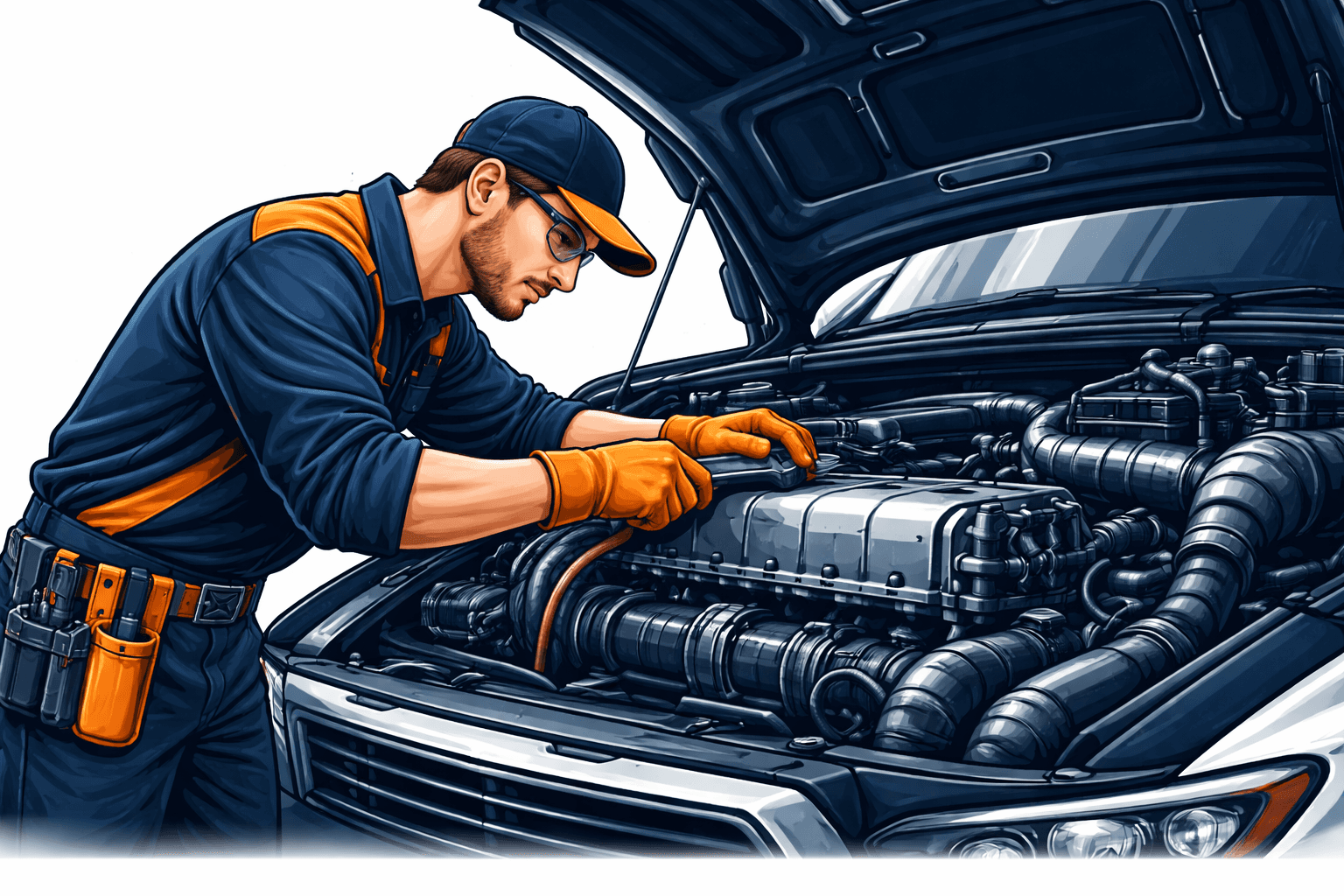
Spark plugs are small, cheap, and easy to forget about - which is exactly why so many people neglect them. I pull spark plugs out of customer cars that look like they survived a war. Electrodes worn to nothing, gaps wide enough to fit a dime, carbon fouling that turns the whole plug black. And then the customer wonders why their car idles rough, gets terrible gas mileage, and feels sluggish. Let me break down everything you need to know about spark plugs so you can keep your engine running the way it should.
What Spark Plugs Actually Do
Your engine is basically an air pump that makes controlled explosions. Here's the cycle: the piston moves down, drawing in a mixture of air and fuel. The piston moves back up, compressing that mixture. At precisely the right moment, the spark plug fires - an electrical arc jumps across the gap between the center electrode and the ground electrode, igniting the compressed air-fuel mixture. The explosion pushes the piston back down, which turns the crankshaft, which ultimately turns your wheels.
This happens thousands of times per minute in each cylinder. At 3,000 RPM, each spark plug fires 1,500 times per minute (once every two crankshaft revolutions in a 4-stroke engine). Over the course of 100,000 miles, a single spark plug fires roughly 100 million times. Let that sink in - 100 million sparks. It's honestly impressive that they last as long as they do.
Each spark needs to be strong enough and precisely timed to fully ignite the air-fuel mixture. When a plug wears out, the spark gets weaker, the gap gets wider, and combustion becomes incomplete. That's where all the symptoms start.
Types of Spark Plugs - Copper, Platinum, Iridium
Not all spark plugs are created equal. The electrode material determines how long the plug lasts and how it performs.
| Plug Type | Electrode Material | Lifespan | Cost Per Plug | Best For |
|---|---|---|---|---|
| Copper / Nickel | Copper core, nickel alloy tip | 20,000 - 30,000 miles | $2 - $5 | Older engines, high-performance applications |
| Single Platinum | Platinum disc on center electrode | 60,000 miles | $5 - $12 | Distributor ignition systems |
| Double Platinum | Platinum on both electrodes | 60,000 - 80,000 miles | $8 - $15 | Waste-spark ignition systems |
| Iridium | Iridium tip on center electrode | 80,000 - 100,000 miles | $8 - $18 | Modern coil-on-plug systems |
| Double Iridium | Iridium on both electrodes | 100,000+ miles | $12 - $25 | Latest vehicles, maximum longevity |
Copper plugs actually provide the best spark - copper is an excellent conductor. The downside is the nickel alloy tip wears out fast. They're cheap, so replacing them every 30,000 miles isn't a big deal on engines where access is easy. Some high-performance and turbocharged engines actually specify copper plugs because of their superior conductivity.
Platinum plugs were the first "long life" plugs. The platinum disc on the electrode resists wear much better than nickel, extending life to around 60,000 miles. If your car has a waste-spark ignition system (where each coil fires two plugs simultaneously), you need double platinum because both electrodes experience wear.
Iridium plugs are the current standard for most modern vehicles. Iridium is harder and has a higher melting point than platinum, allowing for a finer center electrode that produces a more focused spark. Most new cars come from the factory with iridium plugs rated for 100,000 miles.
The key rule: always replace with the same type your vehicle came with, or better. You can upgrade from copper to iridium, but don't downgrade from iridium to copper. Your engine's ignition system is calibrated for the plug type it was designed with.
Replacement Intervals by Plug Type
Here's my professional recommendation on when to replace based on plug type:
| Plug Type | Manufacturer Says | My Recommendation |
|---|---|---|
| Copper | 30,000 miles | 20,000 - 30,000 miles |
| Single Platinum | 60,000 miles | 50,000 - 60,000 miles |
| Double Platinum | 60,000 - 80,000 miles | 60,000 miles |
| Iridium | 100,000 miles | 80,000 - 90,000 miles |
| Double Iridium | 120,000 miles | 100,000 miles |
You'll notice I recommend replacing slightly before the manufacturer's maximum interval. There are two reasons. First, spark plug performance degrades gradually - by the time you hit the max interval, the plugs are working but not working well. Fuel economy has already suffered for thousands of miles. Second, spark plugs that sit in aluminum cylinder heads for 100,000+ miles can seize. The anti-seize compound dries out, carbon builds up on the threads, and corrosion bonds the plug to the head. Removing seized plugs from aluminum heads can require special extraction, sometimes costing $500 or more per plug. Replacing a bit early avoids this nightmare.
Symptoms of Worn Spark Plugs
Your car will give you clear signals when the plugs are wearing out. Here's what to watch for:
Rough idle: The engine shakes or vibrates more than usual at idle. Each time a worn plug fails to fully ignite the mixture, that cylinder produces less power for that cycle. The engine compensates, but you feel the unevenness. This is often the first symptom people notice.
Engine misfire: A misfire is a step beyond rough idle - the plug completely fails to fire in a cylinder. You feel it as a stumble, hesitation, or jerk. Modern engines will usually flash the check engine light during active misfires. A flashing check engine light means unburned fuel is entering the exhaust, which can damage the catalytic converter. Don't ignore a flashing check engine light - that's not a suggestion, it's an urgent warning.
Poor fuel economy: Worn plugs lead to incomplete combustion, which means your engine has to burn more fuel to produce the same power. You might see fuel economy drop by 10% to 30%. If you're suddenly getting fewer miles per tank and nothing else has changed, plugs are a prime suspect.
Hard starting: Especially in cold weather. Worn plugs produce a weaker spark, and cold engines with thicker oil and denser air need a strong spark to fire up. If your car cranks longer than usual before starting, worn plugs could be the cause.
Sluggish acceleration: The car feels lazy, especially under load - merging onto the highway, climbing hills, or passing. This is incomplete combustion reducing power output.
Check engine light: Misfire codes (P0300 through P0312) are among the most common diagnostic trouble codes, and spark plugs are the most common cause. If you get a misfire code, plugs are the first thing to check. For help understanding diagnostic codes, the guides at APEX Tech Nation's diagnostic section can walk you through what they mean.
What Happens If You Ignore Worn Plugs
I want to be real with you about this because I see the consequences in my shop regularly.
Catalytic converter damage: When a spark plug misfires, raw fuel passes through the exhaust unburned and enters the catalytic converter. The converter tries to burn off this excess fuel, generating extreme heat. Over time, this can melt the internal substrate of the converter, destroying it. Catalytic converters cost $500 to $2,500 to replace. All because of a $10 spark plug that wasn't changed on time.
Damaged ignition coils: A worn plug with an excessively wide gap forces the ignition coil to produce higher voltage to bridge that gap. The coil works harder and harder, eventually overheating and failing. Ignition coils cost $30 to $100 each. On a V6 with coil-on-plug, that's 6 coils potentially at risk.
Seized plugs: As I mentioned earlier, plugs that stay in aluminum heads too long can seize. I've spent hours extracting seized plugs with special tools, penetrating oil, and careful technique. When it goes wrong, the cylinder head needs to be removed or the threads need to be repaired with a Heli-Coil insert. What should have been a $200 spark plug job becomes a $1,000+ ordeal.
Wasted fuel: If worn plugs cost you even 15% in fuel economy over 30,000 miles of procrastination, that's hundreds of dollars in extra gas. The plugs are cheaper than the gas you're wasting.
Spark Plug Replacement Cost Breakdown
| Engine Type | Parts (Plugs) | Labor | Total |
|---|---|---|---|
| 4-cylinder (easy access) | $16 - $60 | $40 - $100 | $80 - $200 |
| 4-cylinder (turbo/tight) | $20 - $80 | $80 - $180 | $120 - $300 |
| V6 (easy access) | $30 - $100 | $100 - $200 | $150 - $350 |
| V6 (rear bank difficult) | $30 - $100 | $200 - $400 | $250 - $550 |
| V8 | $40 - $150 | $150 - $300 | $200 - $500 |
| V6/V8 (intake removal needed) | $40 - $150 | $300 - $500 | $350 - $650 |
The massive variation in labor cost comes down to access. On an inline 4-cylinder like a Honda Civic or Toyota Corolla, the plugs are right on top of the engine. Pop off the coils, unscrew the plugs, done. Thirty minutes tops.
On a transverse-mounted V6 - like you find in many sedans and minivans - the rear three plugs are buried against the firewall. Some vehicles (Ford Edge, Toyota Sienna, Chrysler Pacifica, and others) require removing the intake manifold to access the rear bank. That turns a plug change into a 2-3 hour job. It's not the mechanic's fault the price is high - blame the engineers who designed it.
DIY vs Professional Replacement
Here's my honest assessment:
Good DIY candidates:
- 4-cylinder engines with plugs on top (most Honda, Toyota, Hyundai, Kia inline-4s)
- V8 trucks with easy access (Chevy Silverado, Ford F-150 with 5.0)
- Any engine where you can see and reach all plugs without removing other components
Leave it to the shop:
- V6 engines requiring intake manifold removal
- Ford 5.4L 3-valve (notorious for plug breakage - special tools required)
- Subaru boxer engines (plugs are on the sides, awkward access)
- Any engine with over 100,000 miles on original plugs (seizure risk)
If you're doing it yourself, here's what you need:
- Spark plug socket (5/8" or 13/16" depending on plug size) with a rubber insert to grip the plug
- Ratchet with extension bars
- Torque wrench - this is critical. Over-tightened plugs crack the porcelain. Under-tightened plugs can blow out. Follow the torque spec exactly.
- Anti-seize compound (apply a thin coat to the threads, NOT the electrode)
- Gap gauge (verify the gap matches the spec on the sticker under your hood)
- Dielectric grease (for the coil boot connection)
Remove plugs when the engine is warm but not hot. Warm aluminum threads release more easily than cold ones, but a scalding-hot engine will burn you. Let it cool for 30 minutes after driving.
Pro Tips for Spark Plug Maintenance
Always replace all plugs at once. Don't do 3 out of 4 or 4 out of 6. Mismatched plug wear causes uneven combustion across cylinders. Plugs are cheap - do them all.
Inspect the old plugs. They tell a story about your engine's health. A normal plug has a light tan or gray deposit on the electrode. Black, sooty plugs indicate a rich fuel mixture or oil burning. White or blistered plugs indicate an engine running too hot or too lean. Oil-fouled plugs with wet, oily deposits suggest worn valve seals or piston rings. If you see anything unusual, address the underlying problem before installing new plugs.
Don't ignore the coil boots. While the plugs are out, inspect the rubber boots on the ignition coils. Cracked or torn boots allow spark to arc to the cylinder head instead of traveling to the plug, causing misfires. Replace any damaged boots.
Use the right plugs. I can't stress this enough. Don't let a parts store counter person talk you into a "better" plug that's different from what the manufacturer specifies. If your car came with NGK Iridium, put NGK Iridium back in. The heat range, electrode design, and thread reach are all engineered for your specific engine.
Pre-gapped doesn't mean correctly gapped. Most plugs come pre-gapped from the factory, but shipping and handling can change that. Always verify the gap with a feeler gauge before installation. The correct gap for your vehicle is listed in the owner's manual and on the under-hood emissions sticker.
Spark plugs are one of the most overlooked maintenance items because they last so long. But when they go, the symptoms affect everything - power, economy, emissions, and driveability. Stay on top of them and your engine will thank you with smooth, efficient performance for years.