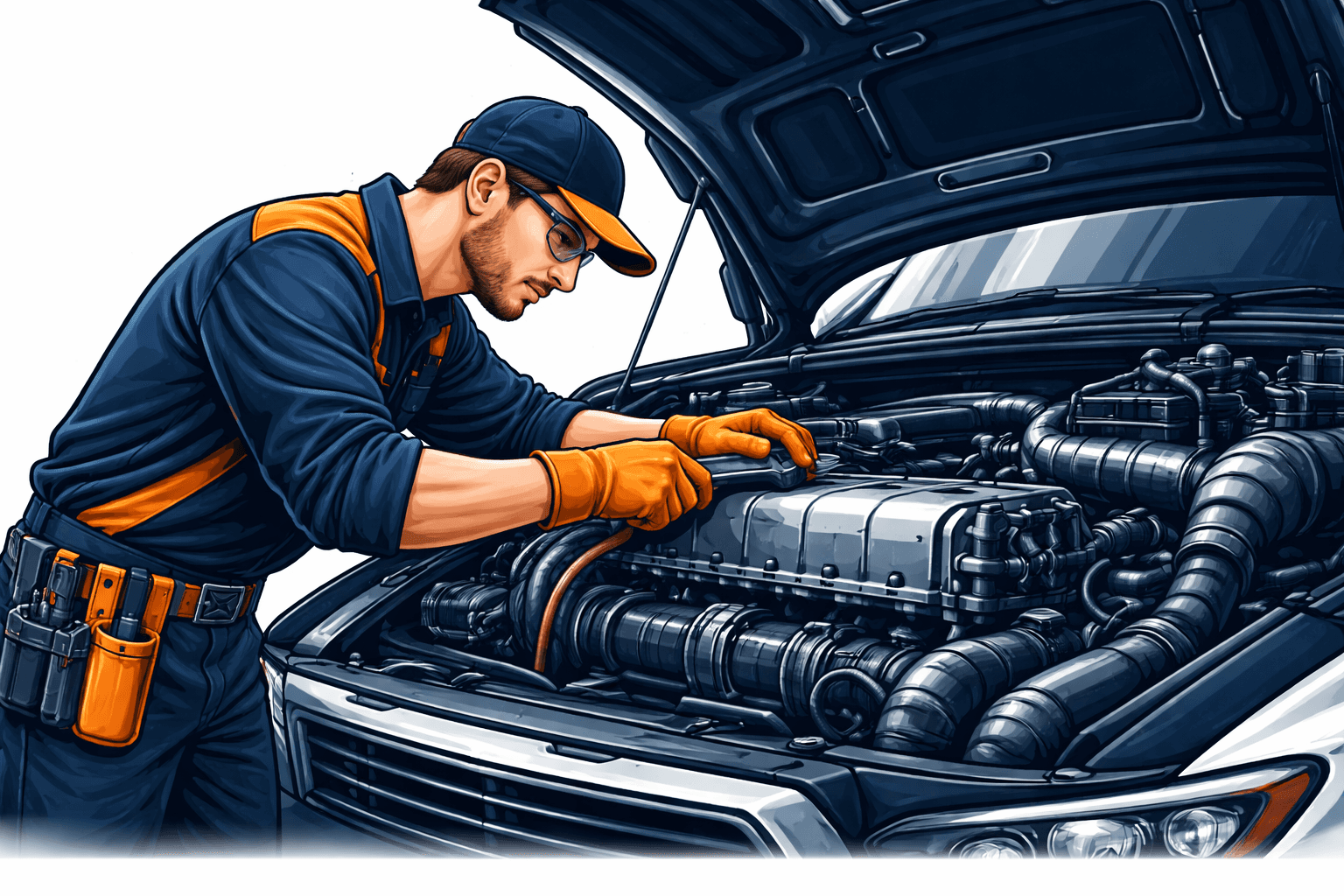
The serpentine belt is one of those parts most people never think about until it fails. And when it fails, everything it powers goes with it - all at once, usually at the worst possible time. I've seen customers stranded on highway shoulders because a $40 belt let go. I've also seen engine overheating and thousands in damage because someone ignored the warning signs. This guide will make sure that doesn't happen to you.
What the Serpentine Belt Drives
Your engine produces mechanical power. The serpentine belt takes some of that power and transfers it to the accessories that make your car comfortable, safe, and functional. Here's what depends on that one belt:
Alternator: This is the generator that charges your battery and powers every electrical system in your car while the engine runs. Without the alternator spinning, your car runs on battery power alone - and that lasts about 20 to 30 minutes before the car dies completely.
Power steering pump: This provides hydraulic assist so you can turn the steering wheel with one finger instead of wrestling it like an arm match. Lose the belt, and steering becomes extremely heavy. You can still steer, but it takes serious effort, especially at low speeds. Not something you want in a parking lot or emergency.
Air conditioning compressor: The AC compressor is driven by the serpentine belt. No belt, no cold air. Not life-threatening, but miserable in July.
Water pump (on many vehicles): This is the big one. On a significant number of vehicles, the water pump that circulates engine coolant is driven by the serpentine belt. If your car is one of these and the belt breaks, coolant stops flowing and your engine will overheat within minutes. Not all vehicles route the water pump off the serpentine belt - some use the timing belt or a separate electric pump - but many do. Check your owner's manual or ask your mechanic.
Other accessories: Some vehicles also use the serpentine belt to drive a secondary air injection pump (for emissions), a supercharger (on supercharged engines), or a vacuum pump (for brake assist on some diesel vehicles).
The point is this: that single belt is responsible for a lot. When people ask me what the most important belt on their car is, this is the one.
When to Replace - Mileage and Time
The general replacement interval for a serpentine belt is 60,000 to 100,000 miles. The range is wide because belt materials have improved significantly over the years.
Older neoprene belts (pre-2000s vehicles) tended to show cracks on the ribbed surface as they aged. These were easy to visually inspect - if you saw cracks, you replaced the belt. These typically lasted 40,000 to 60,000 miles.
Modern EPDM rubber belts are much more durable and often show almost no visible cracking even when they're worn out. Instead, they wear like a tire - the ribs slowly lose material and the belt loses its grip on the pulleys. This makes visual inspection trickier because the belt can look fine while being ready to fail.
| Belt Type | Typical Lifespan | Inspection Method |
|---|---|---|
| Neoprene (older vehicles) | 40,000 - 60,000 miles | Look for cracks, fraying, glazing |
| EPDM (modern vehicles) | 60,000 - 100,000 miles | Measure rib depth with wear gauge |
Beyond mileage, consider age. Rubber degrades over time regardless of mileage. If your belt is more than 7 years old, have it inspected even if the mileage is low. Cars that sit a lot can have belts that look fine mileage-wise but are dry-rotted and brittle from age and heat cycling.
Signs Your Serpentine Belt Needs Replacement
Squealing on startup: A loud squeal when you first start the engine, especially on cold mornings, is the most common sign of a worn or slipping belt. The belt has lost enough material that it can't grip the pulleys properly, so it slips and squeals. This often gets worse in damp or rainy weather because water on the belt surface reduces traction.
Chirping noise: A rhythmic chirping that changes with engine speed often means the belt is misaligned or a pulley bearing is failing. This is different from the full squeal and can be harder to pinpoint. Sometimes it's the belt, sometimes it's the tensioner or an idler pulley bearing.
Visible cracks: On older-style belts, check the ribbed side (the side that contacts the pulleys). Cracks running across the ribs are normal aging. When cracks become deep, frequent (more than 3-4 per inch), or chunks of material are missing, replace the belt.
Glazing: The belt surface looks shiny and smooth instead of having a matte texture. This means the belt has been slipping and the friction has polished the surface, which makes it slip even more. It's a downward spiral.
Material loss on the ribs: For modern EPDM belts, a belt wear gauge (available free at many parts stores) measures the depth of the ribs. When the ribs have worn down past the indicator on the gauge, the belt needs replacement - even if it looks fine visually.
Fraying or damage to edges: If the belt edges are frayed, the belt may be misaligned on a pulley or the tensioner is worn. A fraying belt can jump off its pulleys without warning.
What Happens If It Breaks
When a serpentine belt breaks while driving, here's the sequence of events:
- Battery light comes on - the alternator stops charging immediately.
- Power steering gets heavy - if you have hydraulic power steering, the wheel suddenly becomes very hard to turn.
- AC stops blowing cold - the compressor stops.
- Temperature gauge starts climbing - if your water pump is belt-driven, coolant stops circulating and the engine starts overheating.
- You hear flapping or thumping - the broken belt may slap around under the hood before falling out or wrapping around something.
What to do: Pull over safely as soon as possible. Turn off the AC. If the temperature gauge is climbing, shut the engine off - do not drive an overheating engine even half a mile. Call for a tow.
If your water pump is NOT belt-driven (it's on the timing belt or it's electric), you have a bit more time because overheating isn't an immediate concern. You can drive to a nearby shop, but you're running on battery power alone, so you have maybe 15 to 30 minutes before the electrical system starts failing.
The belt itself is cheap. The damage from driving with a broken belt - overheated engine, warped head, blown head gasket - can cost $2,000 to $5,000 or more. Prevention is always cheaper.
The Tensioner - The Unsung Hero
The serpentine belt tensioner is a spring-loaded pulley that keeps constant tension on the belt. Without proper tension, the belt slips on the pulleys and can't drive the accessories properly.
Tensioners wear out too. The spring weakens over time, the pulley bearing gets noisy, and the arm that holds the pulley can develop play. A worn tensioner is one of the most common causes of belt noise and premature belt failure.
Signs of a bad tensioner:
- Belt squeal that doesn't go away with a new belt
- Visible wobble or flutter in the tensioner arm while the engine runs
- Grinding or growling noise from the tensioner pulley
- The belt keeps coming off
My recommendation: if you're replacing the belt and your car has over 80,000 to 100,000 miles, replace the tensioner and any idler pulleys at the same time. The labor overlaps - the mechanic already has access to everything. You'll pay for the parts ($40 to $150 for the tensioner, $15 to $30 for each idler pulley) but save on labor because it's done in the same job. It's cheap insurance against a breakdown.
Serpentine Belt Replacement Cost
| Service | Parts Cost | Labor Cost | Total |
|---|---|---|---|
| Belt only | $25 - $75 | $50 - $150 | $100 - $250 |
| Belt + tensioner | $75 - $175 | $75 - $200 | $150 - $375 |
| Belt + tensioner + idler pulleys | $100 - $225 | $100 - $250 | $200 - $475 |
Labor time varies a lot depending on the vehicle. On some cars - like a Honda Accord or Toyota Camry - the belt is right on top and takes 20 minutes. On others - like some Subarus, BMWs, or vehicles with the engine crammed in tight - it can take an hour or more. That labor time drives the cost difference.
Compared to what can happen if the belt breaks, this is one of the most cost-effective maintenance items you can do. You're paying $100 to $400 to prevent potential thousands in damage. That's the kind of math I like.
DIY vs Shop - Should You Do It Yourself?
Serpentine belt replacement is one of the more DIY-friendly jobs on a car. Here's what you need:
- The correct belt for your vehicle (get the exact part number from a parts store)
- A wrench or socket that fits the tensioner bolt (sizes vary by vehicle)
- A belt routing diagram - there's usually a sticker under the hood showing how the belt routes around all the pulleys
The process is straightforward: release tension on the tensioner, slide the old belt off, route the new belt according to the diagram, and release the tensioner to tighten on the new belt. On many vehicles, this takes 20 to 45 minutes.
However, some vehicles make this job harder than it needs to be. If the belt is buried under other components, if you can barely reach the tensioner, or if the routing is complex with 7-8 pulleys, it might be worth paying a shop.
One critical tip: take a photo of the belt routing before you remove the old belt. Routing a serpentine belt incorrectly - even one pulley off - can cause the belt to shred immediately or drive an accessory backward. The diagram under the hood helps, but a photo of your specific setup is even better.
If you want guidance on whether a particular repair is DIY-friendly for your specific vehicle, the technicians over at APEX Tech Nation have practical guides that break things down without the jargon.
Prevention and Inspection Tips
Here's how to stay ahead of serpentine belt problems:
Visual inspection every oil change: Pop the hood and take 10 seconds to look at the belt. Check for cracks, fraying, shiny spots, or chunks missing. This alone catches most problems before they become failures.
Listen for changes: Any new squeal, chirp, or noise from the front of the engine on startup deserves attention. Belt noises often get louder over weeks or months - don't tune them out.
Follow your maintenance schedule: If your owner's manual says replace at 90,000 miles, do it at 90,000 miles. Not 120,000. Not "when it starts making noise." Preventive replacement is always cheaper than emergency roadside replacement.
Check tension: If you can twist the belt more than 90 degrees between two pulleys with moderate hand pressure, the tension is too loose. The tensioner may be wearing out.
Keep oil and coolant off the belt: Leaking valve cover gaskets, power steering fluid leaks, or coolant leaks that drip onto the belt will destroy it fast. Oil-soaked belts swell, slip, and deteriorate rapidly. Fix leaks before replacing the belt, or you'll be doing it again soon.
The serpentine belt is a simple, affordable part that does a critical job. Respect it, inspect it, replace it on schedule, and it will never leave you stranded. Ignore it, and it will pick the worst possible moment to remind you it exists.