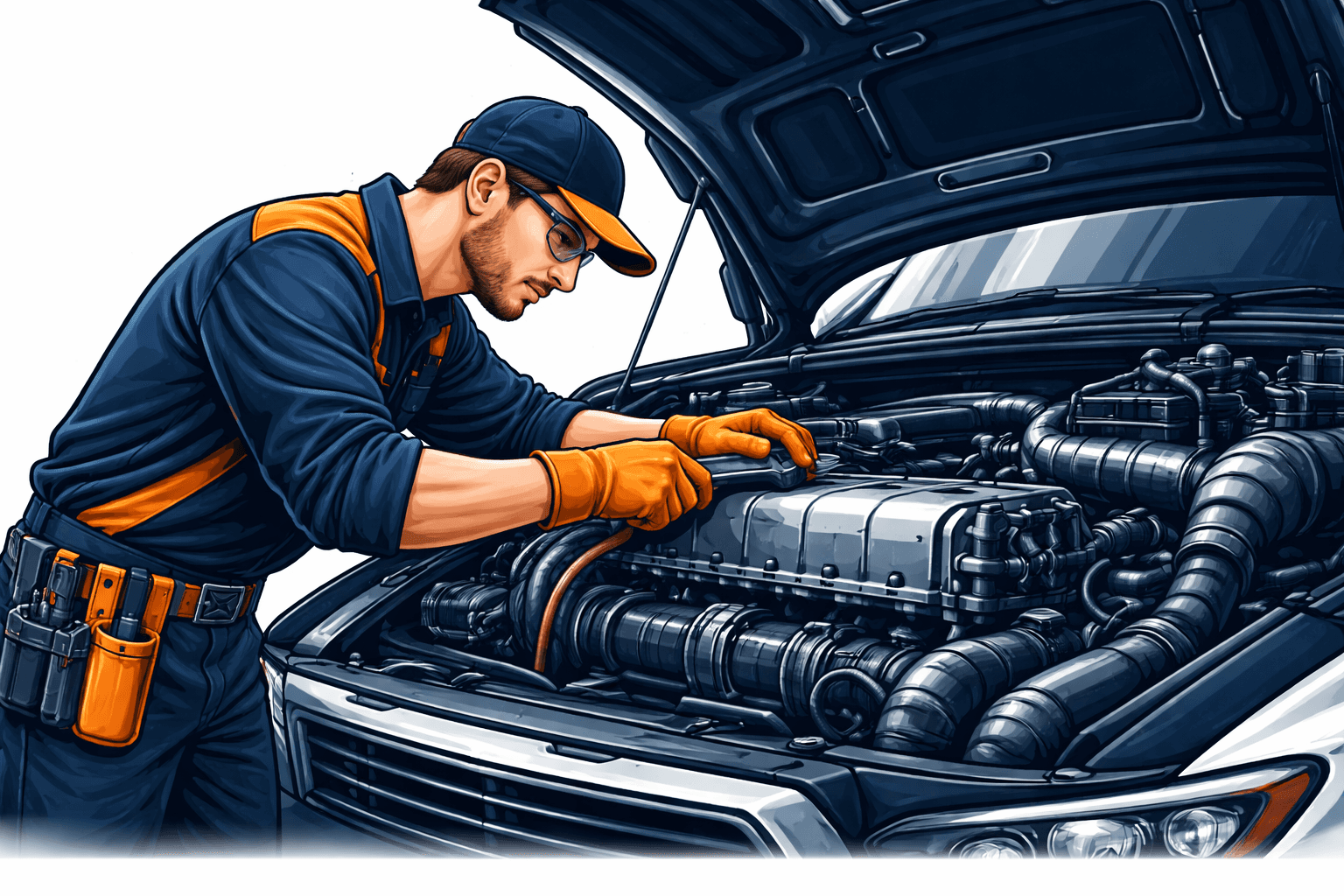
When to Replace Your Battery
Here are the signs your battery is on its way out:
- Slow cranking: The engine turns over slowly when you start it, especially on cold mornings. This is the number one sign.
- Age: The battery is 4+ years old. If you live in a hot climate, 3+ years.
- Battery light on: While often an alternator issue, a failing battery can trigger the battery light.
- Swollen battery case: Heat causes the case to expand. If the battery looks bloated, replace it immediately.
- Corrosion on terminals: Heavy corrosion can indicate an overcharging alternator or a battery that is venting acid.
- Needing frequent jump starts: If you have jumped your car more than once in the last month, the battery is likely done.
What You Need
- Wrench or socket set - 10mm is most common; some vehicles use 13mm
- Work gloves - battery acid is corrosive
- Safety glasses - battery acid can splash
- Wire brush or terminal cleaner (optional but recommended)
- Dielectric grease or anti-corrosion spray (optional but recommended)
- Memory saver (optional - plugs into OBD2 port to keep radio/clock settings during battery swap)
Step-by-Step: How to Change a Car Battery
Step 1: Turn Off Everything and Locate the Battery
Turn off the engine, remove the key, and make sure all lights and accessories are off. Pop the hood. The battery is usually near the front of the engine bay on one side - look for a rectangular box with two thick cables connected to posts on top.
Note: some vehicles have the battery in the trunk (many BMWs, some Chrysler 300s) or under the rear seat (some Audis, Hyundais). Check your owner's manual if you do not see it under the hood.
Step 2: Disconnect the NEGATIVE Terminal First
CRITICAL: Always negative first. The negative terminal is marked with a minus (-) sign and usually has a black cable. Disconnecting negative first prevents short circuits.
Use your wrench to loosen the nut on the negative terminal clamp. You do not need to remove the nut completely - just loosen it enough to wiggle the clamp off the battery post. Tuck the cable aside so it cannot fall back onto the battery terminal.
Step 3: Disconnect the Positive Terminal
Now remove the positive terminal (marked with a plus (+) sign, usually a red cable). Same process - loosen the nut, remove the clamp. Be careful not to let the positive cable or your wrench touch any metal on the car while it is still connected.
Step 4: Remove the Hold-Down
Most batteries are secured with a clamp, bracket, or J-bolt. Remove the bolt(s) and set the hardware aside. Some vehicles use a wedge at the base of the battery - pry it out gently.
Step 5: Lift Out the Old Battery
Grab the battery by the built-in handle (if it has one) or by the edges. Lift straight up. Batteries weigh 30-50 pounds. Lift with your legs. Set it on the ground - never on your car's paint (acid residue can damage the finish).
Step 6: Clean the Cable Ends
Use a wire brush, terminal cleaner tool, or even sandpaper to clean the inside of both cable clamps. You want shiny metal for a good electrical connection. If there is heavy corrosion, a paste of baking soda and water neutralizes battery acid.
Step 7: Install the New Battery
Lower the new battery into the tray. Make sure the terminals are oriented correctly - positive and negative posts need to be on the same sides as the old battery. Reinstall the hold-down bracket and tighten it snugly (not gorilla-tight - you can crack the battery case).
Step 8: Connect POSITIVE First
Attach the red/positive cable to the positive (+) post. Tighten the clamp firmly. Apply dielectric grease or anti-corrosion spray to the connection.
Step 9: Connect NEGATIVE Last
Attach the black/negative cable to the negative (-) post. Tighten the clamp. You might see a small spark - that is normal as the electrical system energizes. Apply grease to this connection too.
Step 10: Start It Up
Start the engine. It should fire right up. The battery light should not be on. Reset your clock, radio presets, and run your power windows fully up and fully down once (this recalibrates the auto-up/down feature on many vehicles).
How to Buy the Right Battery
- Group size: Batteries come in different physical sizes. Your owner's manual or the sticker on the old battery will list the group size (e.g., Group 35, Group 48, Group 78). It has to be the right size to fit the tray and reach the cables.
- CCA (Cold Cranking Amps): This is how much power the battery delivers in cold weather. Match or exceed the original spec. Never go lower.
- Brand: Interstate, ACDelco, Optima, and DieHard are solid choices. Most major-brand batteries are made by the same few manufacturers. Buy from a store with a good warranty.
- Warranty: Look for a 3-year free replacement warranty minimum. Some premium batteries offer 5-year warranties.
- Freshness: Check the date code on the battery. It should be less than 6 months old. Batteries lose charge sitting on shelves.
What It Costs
| Item | DIY Cost | Shop/Store Install |
|---|---|---|
| Standard battery (most cars) | $150-$250 | $170-$300 |
| Premium/AGM battery | $200-$350 | $230-$400 |
| European vehicle battery | $250-$450 | $300-$500 |
| Hybrid auxiliary battery | $200-$400 | $250-$500 |
| Terminal cleaning supplies | $5-$15 | Included |
| Core charge (refunded when you return old battery) | $10-$25 | $10-$25 |
Common Mistakes
- Disconnecting positive first. This is the biggest safety mistake. If your wrench bridges the positive terminal and any metal on the car, you create a short circuit - sparks, heat, potential fire. Always negative first.
- Not cleaning the terminals. A corroded connection means poor contact. The car might start fine at first but develop starting problems or charging issues. Take the 2 minutes to clean them.
- Buying the wrong size. A battery that is too small will not be secured properly and can shift around. A battery that is too big will not fit. Always match the group size.
- Over-tightening the hold-down. You can crack the battery case. Snug is fine - you just need it to not move around.
- Forgetting the core charge. Return your old battery to the store where you bought the new one. You get $10-$25 back, and the old battery gets recycled properly. Do not throw batteries in the trash.
If this kind of hands-on work interests you and you're thinking about a career turning wrenches, APEX Tech Nation's vocational training resources cover everything from basic electrical to advanced diagnostics - all free, all written by working technicians.
Frequently Asked Questions
How often should you replace a car battery?
Most car batteries last 3 to 5 years. In hot climates (Arizona, Texas, Florida), batteries tend to fail faster - closer to 3 years. In cooler climates, 4-5 years is normal. If your battery is over 4 years old, have it tested at least once a year. Do not wait for it to leave you stranded.
Can I change a car battery myself?
Yes. On most vehicles, changing a car battery is a 15-30 minute job that requires only a wrench or socket set (usually 10mm or 13mm). The key safety rule is to always disconnect the negative (black) terminal first and reconnect it last. Some newer vehicles with advanced electronics may need a memory saver or require a battery registration procedure after replacement.
Do I need to reset anything after changing a car battery?
On most vehicles, you will need to reset the clock, radio presets, and possibly the power windows (hold the switch up for 2 seconds after the window is fully up). Your engine may idle rough for a few minutes as the computer relearns idle settings. On some European cars (BMW, Mercedes, VW), you may need to "register" the new battery with a scan tool so the charging system adjusts to the new battery.
Which battery terminal do I disconnect first?
Always disconnect the negative (black, minus sign) terminal first. This prevents accidental short circuits. If you remove the positive terminal first and your wrench touches any metal on the car, you create a short circuit that can cause sparks, burns, or damage to the electrical system. Negative first off, positive first on.
How much does it cost to replace a car battery?
A new car battery costs $150 to $350 depending on size, brand, and type. If you install it yourself, that is your only cost. If a shop or auto parts store installs it, add $20-$50 for labor. Batteries for European luxury vehicles and hybrids can cost $300-$500+.
Can a dead battery damage the alternator?
Yes. A battery with a dead cell or internal short forces the alternator to work overtime trying to charge it. This extra load generates excess heat and can burn out the alternator prematurely. If you replace your battery because it was bad, have the alternator tested too - it may have been stressed by the failing battery.