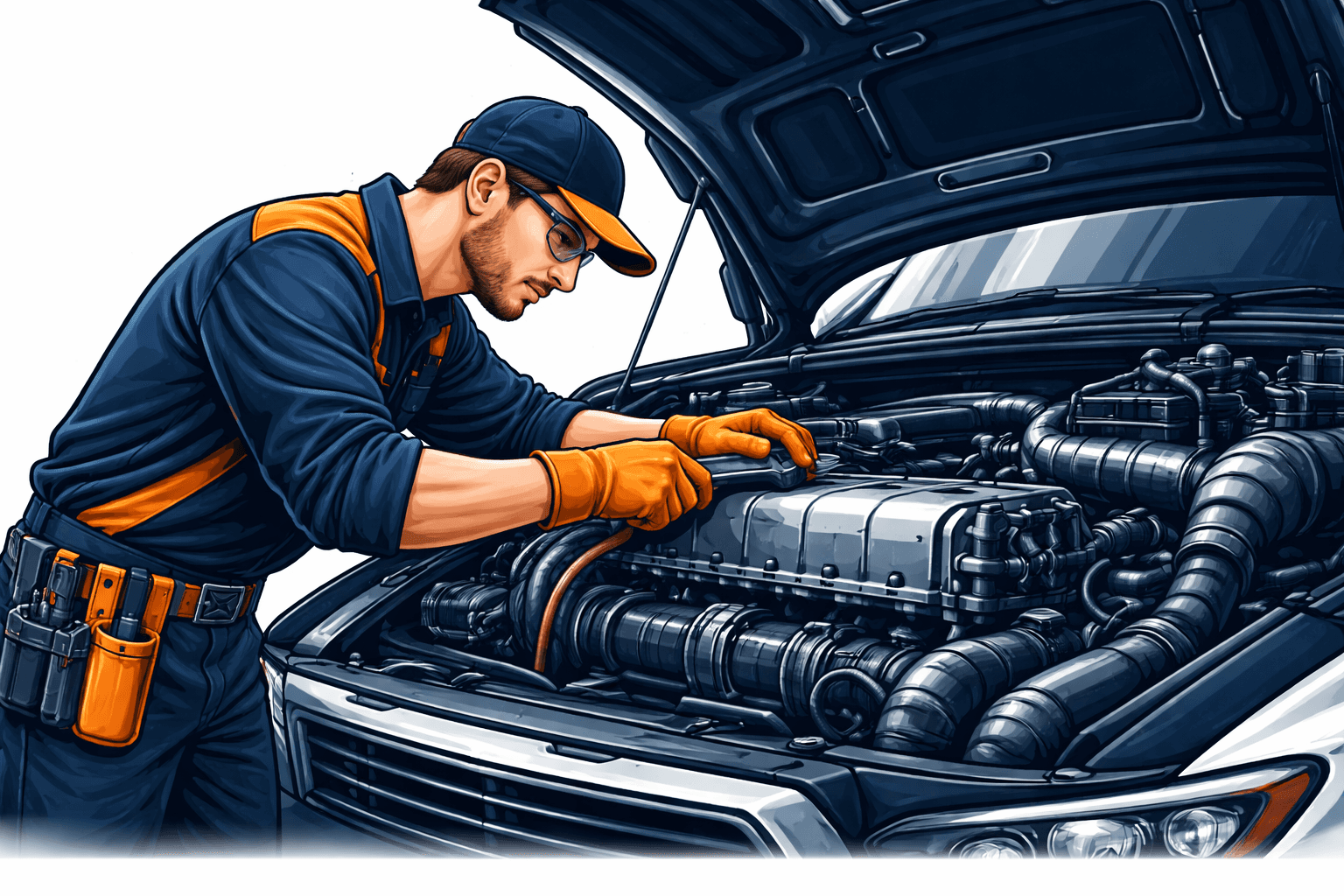
I've rebuilt engines that failed for one simple reason: the owner never checked the oil. They brought the car in smoking, knocking, or seized completely, and every single time it was preventable. Checking your oil takes two minutes and costs nothing. I'm going to walk you through exactly how to do it so you never end up on the side of the road with a destroyed engine.
Why Oil Level Matters More Than Most People Think
Your engine has hundreds of moving metal parts - pistons, crankshaft, camshaft, bearings, valvetrain components - all moving at thousands of RPMs. The only thing keeping them from grinding themselves to dust is a thin film of oil. That film has to be there constantly, under pressure, at the right temperature.
When oil level drops too low, the oil pump starts pulling air instead of oil. Oil pressure drops. The warning light comes on. By that point, damage is already happening. In some cases it happens fast - I've seen engines seize within 10 miles of the light coming on. In others the damage is slower: bearings wear, clearances open up, and eventually the engine starts knocking.
Either way, the repair bill is brutal. A simple engine rebuild can run $2,500 to $5,000. A full replacement - which is sometimes the only option - runs $3,000 to $8,000 on a typical sedan and higher on trucks and SUVs. Compare that to a $25 jug of oil and two minutes of your time every month. That's the math.
Modern cars don't always burn or leak oil. But many do - especially as they age past 80,000 or 100,000 miles. Some manufacturers consider burning a quart every 1,000 miles "within spec," which I think is generous, but the point is: don't assume your car is fine just because you haven't seen a puddle under it. Checking the dipstick is the only way to know for sure.
When to Check Your Oil
Make a habit of checking your oil at least once a month. Pick a day - first of the month, payday, whatever you'll remember - and check it then. It takes two minutes.
Beyond the monthly check, always check your oil before a long road trip. If you're about to drive 300 miles, you want to start with a full crankcase, not discover you're a quart low at a gas station in the middle of nowhere.
Check it more frequently if any of these apply to your car:
- It's over 75,000 miles
- You've noticed a burning smell from the engine bay
- You see any spots or puddles under the car where you park
- The engine occasionally runs rough or ticks at startup
- Your last oil change was more than 3,000 miles ago and the car is older
- The oil pressure or oil level warning light has ever come on
Best time of day to check: After the car has been parked overnight, or after driving and then letting it sit for 5 to 10 minutes. You want the engine off and the oil drained back into the pan for an accurate reading. Don't check immediately after a long highway drive - the oil is still hot and partially circulated, which can read falsely low.
How to Check Oil Level Step by Step
Here's the exact procedure I'd walk any customer through:
- Park on level ground. A sloped driveway will give you an inaccurate reading. Find a flat spot.
- Turn the engine off and wait. If you just drove, wait at least 5 minutes. Overnight parked is ideal.
- Open the hood. Find the hood release lever (usually under the dash on the driver's side), pull it, then release the safety latch at the front of the hood.
- Locate the dipstick. It's usually a brightly colored handle - yellow or orange on most cars - sticking up from the engine. It may be labeled "OIL." Check your owner's manual if you can't find it.
- Pull the dipstick out completely. Wipe it clean with a lint-free rag or paper towel. Wipe all the way from the handle to the very tip.
- Reinsert the dipstick all the way in. Make sure it's fully seated - push it until it stops.
- Pull it out again slowly and hold it horizontal. Read the level before the oil runs down the stick.
- Note the level and the condition of the oil. Compare the oil mark to the MIN and MAX markers on the stick.
That's it. Two minutes from start to finish. The double-dip method (wipe, reinsert, read) is important - the first pull often has oil splashed on it from driving that gives a false reading.
Reading the Dipstick - What It's Telling You
Every dipstick has two reference marks - usually labeled MIN and MAX, or L (low) and F (full), or marked with holes or crosshatching. Here's how to interpret what you see:
- Oil at or above the MAX/F mark: You're full. Perfect. Do nothing.
- Oil between MIN and MAX: You're in the safe zone. If it's closer to MAX you're fine. If it's halfway between the two marks, you might add half a quart.
- Oil at or below the MIN/L mark: You're low. Add oil now, before you drive anywhere.
- No oil visible on the stick at all: This is an emergency. Do not start the engine. Add oil and then check for leaks before driving.
The distance between MIN and MAX on most dipsticks represents about one quart of oil. So if you're at MIN, you need roughly one quart. If you're halfway between the marks, add about half a quart, then recheck.
Oil Color Guide - What Each Color Means
The oil level tells you how much oil you have. The oil color tells you the condition of that oil. Both matter.
- Amber or honey-colored: This is fresh oil. If you see this a week after an oil change, you're in great shape.
- Dark brown: Normal aging. Oil darkens as it absorbs combustion byproducts. This is not a problem by itself, but it's telling you an oil change is coming up.
- Black: Oil is overdue for a change. It's still lubricating but it's been working hard. Schedule a change soon.
- Milky, grey, or light tan (looks like a latte): Coolant is mixing with the oil. This is a serious problem - usually a blown head gasket or cracked head. Stop driving the car and get it to a shop immediately.
- Foamy or bubbly: Same as above - coolant contamination. Or air is getting into the oil system. Either way, stop driving and get it checked.
- Metallic flakes or gritty texture: Internal engine damage. Metal particles are circulating through the engine. This is expensive. Get a diagnosis before driving further.
Smelling the oil on the dipstick also gives you information. Fresh oil has a mild petroleum smell. Old oil smells harsh or acrid. If it smells like gasoline, fuel is getting into the oil - another problem that needs attention.
How to Add Oil When You're Low
If your level is low, here's how to top it off properly:
- Find the oil filler cap. It's on top of the engine, usually labeled with an oil can symbol or the word "OIL." It twists off counterclockwise.
- Use the correct oil for your car. Check your owner's manual for the right viscosity grade (like 5W-30 or 0W-20). Using the wrong grade won't destroy the engine in the short term, but use the right stuff whenever possible.
- Add oil slowly. Pour in about half a quart at a time. It's easier to add more than to deal with overfilling.
- Wait 60 seconds, then recheck the dipstick. Oil needs a moment to drain down into the pan.
- Repeat until you're near (but not above) the MAX mark.
- Replace the filler cap securely. A loose cap will spray oil all over the engine bay - not a fun cleanup.
One quart of oil at a shop or parts store runs $6 to $12 depending on the brand and type. Synthetic oil costs a bit more. Keep a spare quart in your trunk - it takes almost no space and could save your engine someday.
Overfilling - Yes, Too Much Oil Is Also a Problem
Most people worry about low oil. Fewer realize that too much oil is also harmful. If the oil level is above the MAX mark, here's what happens:
The crankshaft - a large rotating component in the bottom of the engine - will start beating and whipping the excess oil into foam. Foamy oil doesn't lubricate properly. You get the same result as low oil: engine damage. The overfilled oil can also push past seals and gaskets, causing leaks that didn't exist before.
If you overfill by more than half a quart, it needs to come out. A shop can drain some oil out relatively quickly for a small charge. Don't drive on significantly overfilled oil.
What It Means When Your Car Burns Oil
If you find yourself adding oil between changes - more than a quart every 3,000 miles - your engine is burning oil or leaking it somewhere. Here are the most common causes:
- Worn piston rings: Rings are supposed to seal combustion gases in and keep oil out of the combustion chamber. As they wear, oil sneaks past and burns with the fuel. Blue-grey smoke from the exhaust is a giveaway.
- Worn valve stem seals: Valves open and close thousands of times per minute. The seals around their stems keep oil from getting into the combustion chamber. When they harden and crack with age, oil burns. You'll see a puff of smoke on startup after the car has been sitting.
- External oil leaks: Oil pan gasket, valve cover gasket, rear main seal - any of these can leak oil that burns off on hot exhaust components. You'll smell it but may not see puddles if it's burning off.
Some oil consumption is considered normal, especially in higher-mileage engines. But if you're adding more than a quart every 1,000 miles, it needs to be investigated. The fix depends on the cause - valve stem seals are relatively affordable, piston rings often mean a full engine rebuild.
If you want to dig deeper into what causes engine oil leaks and what repairs cost, I break it all down at APEX Tech Nation - a free resource built specifically to help car owners understand what's happening under the hood.
When to Stop DIYing and See a Technician
Checking oil is something every car owner can and should do. But some of what you find when you check it requires professional diagnosis. Go to a shop if:
- The oil is milky or foamy (coolant contamination)
- You find metal particles in the oil
- The level drops more than a quart between changes consistently
- The oil pressure warning light comes on while driving
- The engine knocks or ticks even when oil level is correct
- You smell burning oil inside the cabin while driving
These are symptoms, not the root problem. A technician has the tools to pressure-test the cooling system, do a compression test, check for external leaks, and figure out exactly what's happening. Catching these things early almost always costs far less than waiting until they become engine failures.
Check your oil once a month. It's the single highest-return maintenance task you can do for your car. Two minutes a month versus a potential $5,000 engine repair. That's the deal.