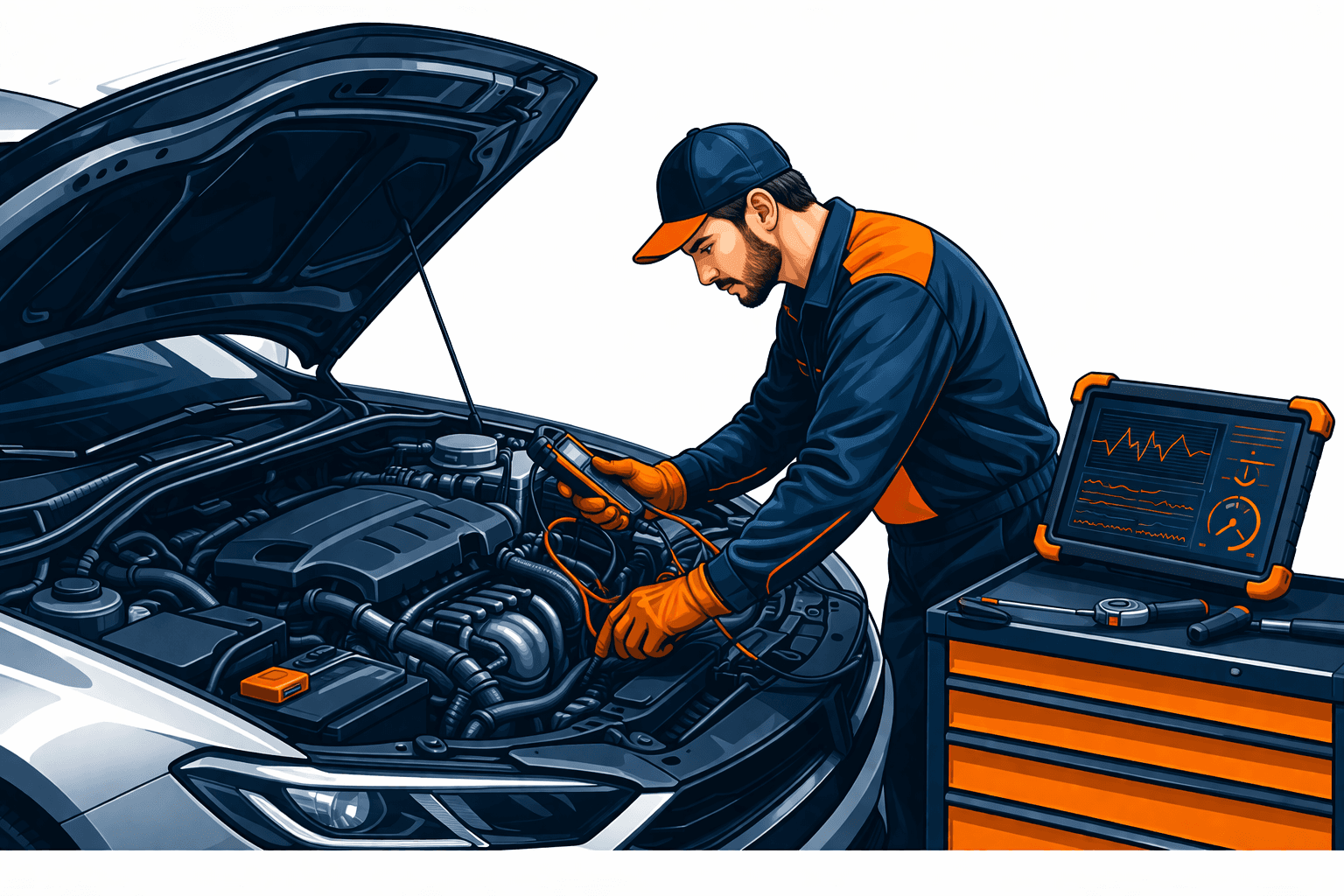
What the Battery Light Actually Means
Let me clear up the biggest misconception right now: the battery light does not mean your battery is bad. It means your charging system is not working.
Here's how your car's electrical system works in simple terms:
- The battery stores electrical energy and provides the big burst of power needed to start the engine.
- The alternator is a generator driven by the serpentine belt. Once the engine is running, the alternator produces electricity to power everything in the car AND recharge the battery.
- The voltage regulator (usually built into the alternator) keeps the voltage between 13.5 and 14.8 volts.
When your car's computer detects that system voltage has dropped below about 12.5 volts or is not within the expected range, it turns on the battery light. The most common reason? The alternator stopped doing its job.
Think of it like this: the battery is a gas can, and the alternator is the gas station. The battery light means the gas station is closed - you are running on whatever is left in the can.
Common Causes of a Battery Light
Here are the causes I see most often:
1. Failed Alternator (Most Common - About 50% of Cases)
Alternators have internal components - diodes, bearings, brushes, and windings - that wear out over time. Most alternators last 100,000 to 150,000 miles, but I have seen them fail as early as 60,000 miles, especially on vehicles that sit in traffic a lot or run heavy electrical loads (big stereo systems, aftermarket lighting, etc.).
A failing alternator might give you warning signs: dimming headlights, slow power windows, a whining noise from the engine bay, or the battery light flickering before staying on permanently.
2. Broken or Slipping Serpentine Belt
The serpentine belt drives the alternator. If the belt breaks, the alternator stops spinning and stops generating power. You will also lose power steering and AC at the same time, because the same belt drives those too.
A slipping belt (due to wear, a weak tensioner, or oil contamination) can cause intermittent charging - the battery light flickers on and off, especially at idle or when you turn on the AC.
3. Corroded or Loose Battery Connections
The simplest cause and the cheapest fix. Corrosion on the battery terminals (that white or green crusty buildup) increases resistance and prevents proper charging. I have fixed countless battery lights with nothing more than a wire brush, a terminal cleaner tool, and 10 minutes of work.
4. Bad Battery
A battery with a shorted cell or one that can no longer hold a charge can confuse the charging system and trigger the light. Batteries typically last 3 to 5 years. If yours is in that range and the light comes on, have the battery tested - most auto parts stores do this for free.
5. Wiring Problems
The charging system relies on specific wires between the alternator, battery, and fusible links. Damaged, chafed, or corroded wiring can cause intermittent or permanent charging failures. This is especially common on older vehicles or vehicles that have had underhood work done recently.
6. Failed Voltage Regulator
On most modern cars, the voltage regulator is built into the alternator, so a failed regulator means a new alternator. On some older vehicles (and some Fords), the regulator is a separate component that can be replaced independently.
Can You Drive With the Battery Light On?
Short answer: you can drive, but you are on a countdown timer.
Once the alternator stops charging, your car runs entirely on whatever charge is left in the battery. Here is what to expect:
- Daytime, minimal electronics: 30-45 minutes
- Nighttime with headlights: 15-25 minutes
- AC, heated seats, stereo all running: maybe 15 minutes
When the battery finally dies, here is what happens in order:
- Dashboard lights dim and gauges start acting erratic
- Power steering gets stiff (electric power steering) or stays normal (hydraulic)
- Headlights dim significantly
- Engine stalls and will not restart
What to do RIGHT NOW if your battery light is on: Turn off the AC, radio, heated/cooled seats, and anything else you do not absolutely need. If it is nighttime, you need headlights - keep those on. Drive directly to the nearest safe location or repair shop. Do not take the highway if you can avoid it - getting stranded at highway speed is dangerous.
How to Diagnose a Battery Light
Step 1: Check the Serpentine Belt
Pop the hood and look at the belt. Is it there? Is it intact? Is it loose or cracked? If the belt is broken or missing, that is your problem. A new belt and possibly a tensioner will fix it.
Step 2: Check Battery Connections
Look at the battery terminals. If you see white, green, or blue corrosion buildup, clean the terminals with a wire brush and terminal cleaner. Make sure the connections are tight - you should not be able to wiggle them by hand.
Step 3: Test the Battery
Most auto parts stores (AutoZone, O'Reilly, Advance Auto) will test your battery for free. They use a conductance tester that tells you the battery's state of charge and state of health. If the battery has a bad cell, it needs to be replaced.
Step 4: Test the Alternator
With the engine running, a healthy charging system should read 13.5 to 14.8 volts at the battery terminals. You can check this with a basic multimeter ($15-$20 at any hardware store). If you are reading battery voltage only (12.0-12.6 volts) with the engine running, the alternator is not charging.
Step 5: Professional Diagnosis
If the belt, connections, and battery all check out, you need a shop to do a full charging system diagnosis. They will check alternator output under load, test the voltage regulator, and inspect the wiring. This typically costs $80-$150.
Repair Costs
| Repair | Parts | Labor | Total |
|---|---|---|---|
| Clean battery terminals | $5-$10 | $0-$30 | $5-$40 |
| New serpentine belt | $25-$75 | $50-$125 | $75-$200 |
| Belt tensioner | $40-$100 | $75-$150 | $115-$250 |
| New battery | $150-$300 | $0-$50 | $150-$350 |
| New alternator | $200-$500 | $150-$300 | $350-$800 |
| Wiring repair | $20-$100 | $80-$300 | $100-$400 |
Common Mistakes People Make
- Replacing the battery when the alternator is bad. The new battery works great for a day or two, then dies because the alternator never charged it. Always test the charging system, not just the battery.
- Ignoring an intermittent battery light. A flickering battery light is a warning that failure is coming. Fix it on your schedule, not on the side of the highway.
- Driving long distances with the light on. You are gambling. If the battery dies on the highway, you lose power steering and the engine stalls. That is dangerous.
- Using a cheap aftermarket alternator. Remanufactured alternators from auto parts stores have a high failure rate. If you can afford it, go OEM or a quality reman from a reputable rebuilder.
If you want to understand your car's electrical system at a deeper level - how alternators, voltage regulators, and charging circuits actually work - APEX Tech Nation's charging system breakdown covers it the way I'd explain it in the shop.
Frequently Asked Questions
What does the battery light on my dashboard mean?
The battery light means your vehicle's charging system is not working properly. It does not necessarily mean your battery is dead. Most often it means the alternator has failed or the serpentine belt that drives it has broken. Your car is running on stored battery power only, which will run out in 20-45 minutes.
Can I drive with the battery light on?
You can drive short distances, but you are on borrowed time. Once the battery drains completely, you will lose power steering, your engine will stall, and you will be stranded. Drive directly to the nearest safe location or repair shop. Turn off all non-essential electronics (AC, radio, heated seats) to extend your remaining battery life.
How long can I drive with the battery light on?
If your alternator has completely failed, you typically have 20 to 45 minutes of driving before the battery dies. This varies by battery condition, how many electrical accessories are running, and whether it is daytime or nighttime (headlights draw significant power). Do not count on more than 30 minutes.
How much does it cost to fix a battery light?
Repair costs depend on the cause. A new serpentine belt costs $75-$200 installed. A new alternator runs $350-$800 for most vehicles. A new battery is $150-$350. Wiring repairs vary from $100-$400. The diagnostic fee is usually $80-$150 at most shops.
Can a bad battery cause the battery light to come on?
Yes, but it is less common than alternator failure. A battery with a dead cell or internal short can trigger the battery light because the charging system detects abnormal voltage. If your battery is more than 4-5 years old and the light comes on, have both the battery and alternator tested.
Why did my battery light come on then go off?
An intermittent battery light usually means a loose or corroded connection, a slipping serpentine belt, or an alternator that is starting to fail but has not completely died yet. Do not ignore it. Intermittent problems become permanent failures, usually at the worst possible time.