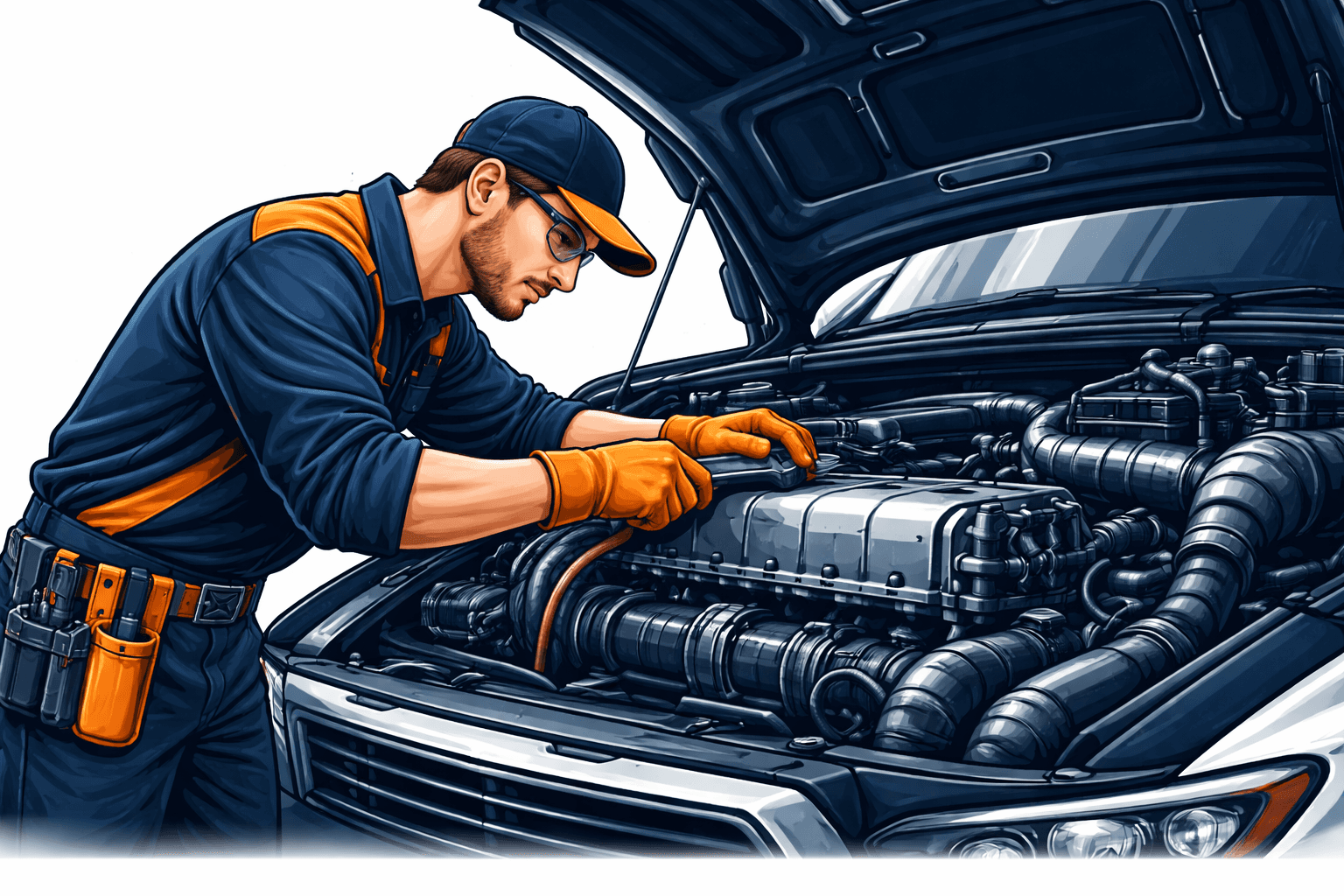
I've replaced thousands of car batteries over my career, and the story is almost always the same: customer comes in saying "it was fine yesterday, and this morning it wouldn't start." That's how batteries die - they work fine until they don't. There's rarely a slow, obvious decline. One day the car starts perfectly, the next day you turn the key and hear that dreaded slow crank or just a click. I want to help you avoid that surprise. Let me walk you through everything you need to know about your car battery - how long it should last, how to spot the warning signs, and when to replace it before it leaves you stranded.
Average Car Battery Lifespan
The straight answer: 3 to 5 years for most conventional lead-acid batteries. That's the national average. But "average" covers a wide range, and where you live makes a huge difference.
If you live in the southern US - Texas, Arizona, Florida, the Carolinas - expect closer to 3 years. If you're in the northern states or the Pacific Northwest with milder summers, 4 to 5 years is realistic. I'll explain why in the heat vs. cold section below.
Some premium batteries, particularly AGM (Absorbent Glass Mat) batteries, can last 5 to 7 years in favorable conditions. But even the most expensive battery has a finite life. The chemical reactions that produce electricity also gradually destroy the internal lead plates. It's an unavoidable process.
Here's something a lot of people don't consider: your driving habits affect battery life. Short trips - under 15 minutes - are the worst for batteries. The engine cranking draws a lot of power, and the alternator needs at least 15 to 20 minutes of driving to fully recharge the battery after starting. If you only drive short hops around town, your battery stays in a partially discharged state, which accelerates degradation. Highway commuters tend to get longer battery life than city-only drivers for exactly this reason.
Signs Your Battery Is Dying
Unlike brake pads or tires, batteries don't give you a lot of gradual warning. But there are signs if you know what to look for.
Slow cranking: This is the classic sign. When you turn the key or press the start button, the engine turns over slowly - "rrrr... rrrr... rrrr..." instead of the snappy "vroom" you're used to. The starter motor needs a lot of current to spin, and a weak battery can't deliver it. If you notice slow cranking, especially on a warm day, your battery is telling you something. Don't wait for it to get worse.
Dim headlights at idle: If your headlights noticeably dim when you're sitting at a red light but brighten when you rev the engine, the battery isn't holding charge well and the alternator is compensating. This is easier to spot at night.
Needing a jump start: If you've needed a jump in the last few months and the battery is more than 3 years old, replace it. A healthy battery doesn't randomly go flat unless you left the lights on. One jump might be a fluke. Two jumps - it's time.
Battery warning light: The battery-shaped light on your dashboard monitors the charging system. If it comes on while driving, it usually means the alternator isn't charging properly, but it can also indicate a battery that can no longer accept a charge. Either way, get it checked promptly.
Swollen or bloated case: If the battery case looks puffed up or swollen on the sides, the battery has been exposed to excessive heat and the internal plates are gassing excessively. A swollen battery is a failed battery - replace it immediately. It can also be a safety hazard.
Excessive corrosion: Some corrosion on battery terminals is normal, especially on the positive terminal. But heavy, crusty buildup - particularly a blue-green fuzz - can indicate the battery is venting acid, which often happens as batteries age. Clean the terminals, but also consider the battery's age.
Electrical gremlins: Flickering dashboard lights, the radio resetting itself, windows moving slowly, or the clock losing time can all be signs of an unstable power supply from a failing battery.
The smell of rotten eggs: A strong sulfur smell near the battery means it's venting hydrogen sulfide gas due to an internal short or overcharging. This is not just a battery problem - it's a safety concern. Hydrogen gas is flammable. Get it checked and replaced right away.
Heat vs Cold - What Really Kills Batteries
This is one of the biggest misconceptions in car care: most people think cold weather kills batteries. The truth is the opposite - heat kills batteries, and cold exposes the damage.
Here's what actually happens. During hot summer months, the heat under your hood accelerates the chemical reactions inside the battery. The electrolyte (sulfuric acid and water) evaporates faster. The internal lead plates corrode more rapidly. Grid corrosion - the gradual breakdown of the lead grid structure that supports the active material - is heavily temperature-dependent. Studies show that for every 15 degrees Fahrenheit above 77 degrees, battery life is cut roughly in half.
So a battery baking in a 140-degree engine bay in Phoenix is aging dramatically faster than the same battery in Portland. The damage accumulates all summer.
Then winter comes. Cold temperatures thicken engine oil, making the starter motor work harder. At the same time, cold reduces the battery's available power - a fully charged battery at 80 degrees F delivers 100% of its rated cranking amps, but at 0 degrees F, it can only deliver about 60%. So just when the engine needs MORE power to start, the battery can deliver LESS.
A healthy battery handles this fine. But a battery that spent the summer cooking in the heat no longer has full capacity. The first cold snap reveals the damage, and that's when people get stranded. This is why battery replacement shops are busiest in the fall and early winter - the summer heat killed the batteries, and the first cold morning finishes them off.
| Temperature | Battery Capacity | Engine Cranking Load |
|---|---|---|
| 80°F (27°C) | 100% | Normal |
| 32°F (0°C) | ~80% | ~1.5x higher (thicker oil) |
| 0°F (-18°C) | ~60% | ~2x higher |
| -20°F (-29°C) | ~40% | ~2.5x higher |
The takeaway: if you live in a hot climate, have your battery tested every fall, starting at age 2 years. If you live in a moderate climate, start testing at age 3.
How to Test Your Car Battery
There are two main ways to test a battery, and they measure different things.
Voltage test (basic): Using a multimeter, measure the voltage across the battery terminals with the engine off. Here's what the numbers mean:
| Resting Voltage | Approximate Charge Level |
|---|---|
| 12.6V or higher | Fully charged (100%) |
| 12.4V | ~75% charged |
| 12.2V | ~50% charged |
| 12.0V | ~25% charged |
| Below 11.9V | Effectively dead |
The voltage test tells you the current state of charge but NOT the battery's health. A battery can show 12.6 volts and still fail under load because the internal plates are degraded. That's where the load test comes in.
Load test (comprehensive): This applies a heavy electrical load to the battery (usually half of its CCA rating) for 15 seconds while monitoring voltage. A healthy battery should maintain at least 9.6 volts under load at 70 degrees F. If the voltage drops below 9.6V, the battery is failing internally even if the resting voltage looks fine.
Most auto parts stores - AutoZone, O'Reilly, Advance Auto - will test your battery for free with an electronic battery tester. These modern testers are more sophisticated than a simple load test. They measure internal resistance and can estimate remaining battery life. I strongly recommend getting this done once a year after your battery hits 3 years of age.
You can also check the battery's condition through the built-in indicator eye (if equipped). Many batteries have a small round window on top. Green means charged, dark/black means needs charging, and clear/yellow means the battery is dead and needs replacement. This indicator is basic but useful for a quick visual check.
CCA Ratings Explained
CCA (Cold Cranking Amps) is the most important number when buying a battery. It measures the battery's ability to deliver power in cold conditions - specifically, the number of amps the battery can supply at 0°F (-18°C) for 30 seconds while maintaining at least 7.2 volts.
Why does this matter? Because starting your engine on a cold morning is the hardest thing your battery does. Thick oil, cold metal, and stiff seals all make the starter work harder. The higher the CCA rating, the more cold-weather starting power you have.
You'll also see CA (Cranking Amps), which is measured at 32°F instead of 0°F. CA numbers are always higher than CCA for the same battery because the test is less demanding. Some manufacturers use CA to make their batteries look more powerful on the label. Always compare CCA to CCA.
Reserve Capacity (RC) is another useful spec. It measures how many minutes the battery can deliver 25 amps at 80°F before dropping below 10.5 volts. This tells you how long the battery can run essential systems if the alternator fails. Higher RC gives you more time to get to safety.
When replacing your battery, always match or exceed the CCA rating specified in your owner's manual. Going higher is fine - a battery with more CCA than needed won't harm anything. Going lower means you might not have enough power to start in cold weather.
Battery Types and Which to Buy
| Battery Type | Price Range | Lifespan | Best For |
|---|---|---|---|
| Flooded Lead-Acid (standard) | $80 - $160 | 3 - 5 years | Most vehicles, budget-friendly |
| AGM (Absorbent Glass Mat) | $150 - $300 | 4 - 7 years | Start-stop vehicles, high electrical demand, vibration-prone |
| Enhanced Flooded (EFB) | $120 - $200 | 4 - 6 years | European start-stop vehicles |
| Lithium (LiFePO4) | $200 - $500 | 5 - 10 years | Weight savings, enthusiast builds (not for all vehicles) |
Standard flooded batteries are what most cars use. They're affordable, widely available, and work fine for vehicles with standard electrical demands. The electrolyte is a liquid that can spill if the battery is tipped, and they're more susceptible to vibration damage.
AGM batteries are the upgrade pick. The electrolyte is absorbed into fiberglass mats between the plates, so there's no free-flowing liquid. They handle vibration better, discharge more slowly, recharge faster, and last longer. If your car came with an AGM battery (common on newer European vehicles and anything with start-stop technology), you must replace it with an AGM. If your car came with a standard battery, upgrading to AGM is a good investment if you plan to keep the car.
One important note: vehicles with start-stop systems (the engine shuts off at red lights to save fuel) require either AGM or EFB batteries specifically designed for the high cycle demands. Using a standard flooded battery in a start-stop vehicle will result in premature failure and possibly system malfunctions.
For help choosing the right battery and understanding your vehicle's electrical system, the technicians at APEX Tech Nation have practical guides that cut through the marketing jargon.
When to Replace Preventively
I'm a big believer in preventive battery replacement. Here's why: a battery costs $100 to $250. A tow truck costs $75 to $150. Being late to work, missing an appointment, or getting stranded in a bad area - those costs are harder to calculate but very real.
My preventive replacement timeline:
- Hot climate (southern US): Test annually starting at year 2. Replace proactively at year 3-4, or immediately if the test shows weakness.
- Moderate climate: Test annually starting at year 3. Replace proactively at year 4-5.
- Cold climate (northern US): Test annually starting at year 3. Replace before winter if the test shows any decline. The last thing you need is a dead battery at -10°F.
The best time to replace a battery is on a Saturday morning at home when you planned it, not on a Tuesday morning in a parking garage when you didn't.
Most auto parts stores test batteries for free and will install the new one for free if you buy it there. Many even offer a core credit of $10 to $20 for turning in your old battery (they recycle the lead and acid). There's really no reason to push a battery past its comfortable lifespan.
When you do replace, make sure you record the date. Write it on the battery with a permanent marker, keep the receipt in your glovebox, or set a reminder on your phone for 3 years from now to start testing. You won't remember otherwise - nobody does.
Tips to Make Your Battery Last Longer
You can't make a battery last forever, but you can avoid shortening its life unnecessarily.
Drive regularly and for adequate distances. Short trips of under 15 minutes don't give the alternator enough time to fully recharge the battery after starting. If most of your driving is short-hop city stuff, consider taking a longer drive once a week to give the battery a full charge. Or use a battery maintainer if the car sits for extended periods.
Keep the terminals clean. Corrosion on the terminals creates resistance, which makes the charging system work harder and can prevent the battery from reaching full charge. Clean the terminals once or twice a year with a wire brush or a terminal cleaning tool (costs about $5). Apply a thin coat of dielectric grease or terminal protector spray afterward.
Make sure the battery is properly secured. Vibration is a battery killer. The hold-down bracket that secures the battery in its tray exists for a reason - vibration can crack the internal plates, cause shorts, and dramatically shorten battery life. If your battery rattles or shifts in its tray, tighten or replace the hold-down hardware.
Turn everything off before shutting down. Lights, radio, fans, heated seats - turn them off before you turn off the engine. This reduces the electrical load during the next startup and prevents accidentally leaving accessories on that drain the battery.
Don't let it fully discharge. Deep discharging a lead-acid battery damages the plates through a process called sulfation, where lead sulfate crystals form and harden on the plates. A fully discharged battery that sits for days or weeks may never fully recover. If you accidentally kill the battery, recharge it as soon as possible.
Heat shield check. Many vehicles have a heat shield or insulating sleeve around the battery to protect it from engine heat. If this shield is missing or damaged, the battery is exposed to higher temperatures and will die sooner. If your car had one and it's gone, replace it. They're usually $15 to $30 and make a real difference in battery life.
Watch for parasitic draw. If your battery keeps dying overnight or after sitting for a day or two, you may have a parasitic electrical draw - something staying on when the car is off. Common culprits include trunk lights that don't turn off, aftermarket stereos, dash cameras wired directly to the battery, or a failing body control module. A technician can measure parasitic draw with a multimeter to identify the source. Normal parasitic draw is 25 to 50 milliamps. Anything above 75 to 100 milliamps will drain the battery prematurely.
Your car battery is a simple part with a simple job - provide the jolt of power needed to start your engine and run your electronics. Respect its limitations, test it regularly as it ages, and replace it before it strands you. It's one of the cheapest and easiest forms of insurance for keeping your car reliable and getting you where you need to go.