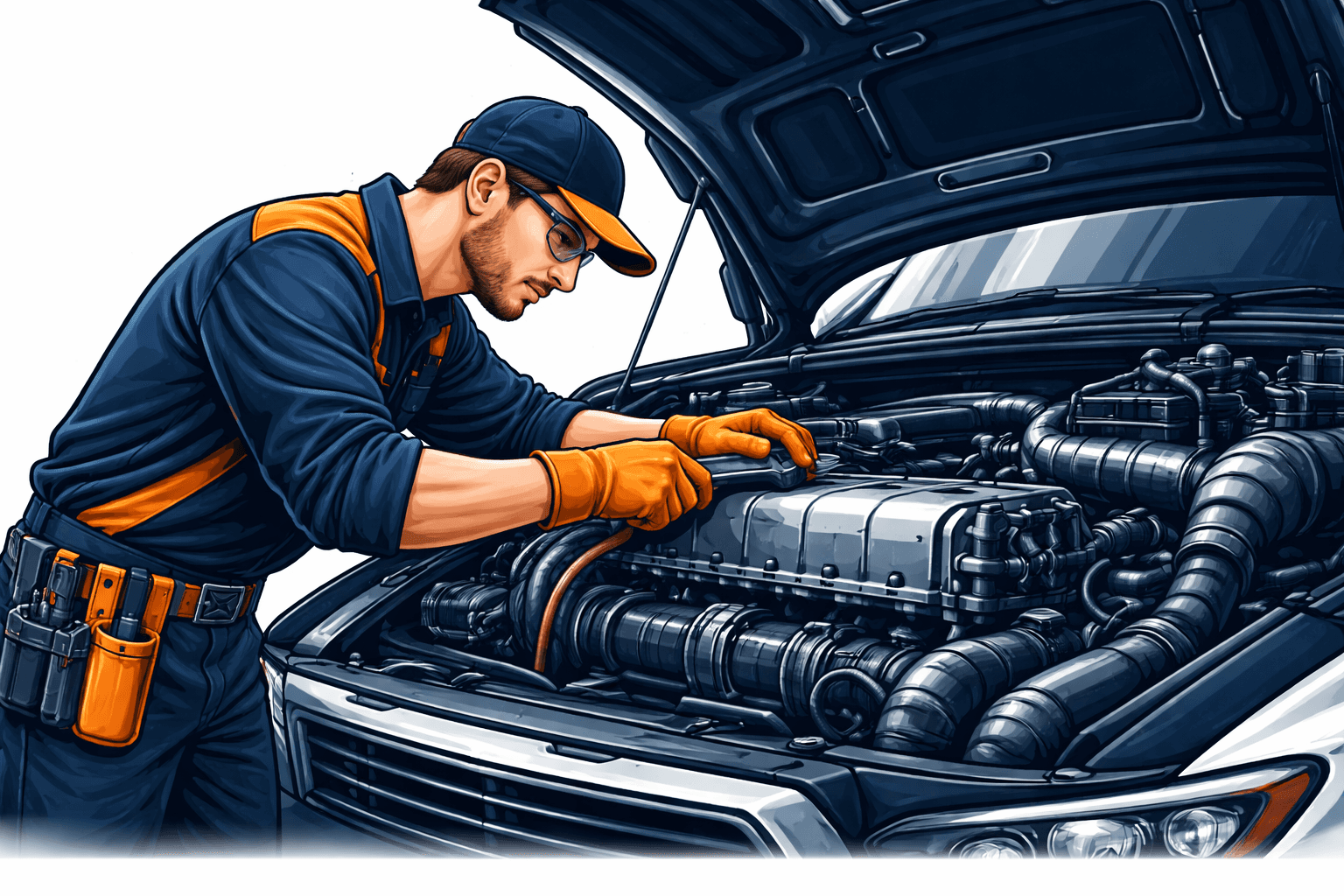
One of the most common misdiagnoses I see from other shops and DIYers is blaming the battery when the alternator is the actual problem. I've lost count of how many customers have told me "I just replaced the battery and it died again" - because the alternator wasn't charging it. Let me explain what the alternator does, how it works, and how to tell when it's failing so you don't end up stranded.
What the Alternator Does
Your car needs electricity to run. Not just for the radio and headlights - the engine computer, fuel injectors, ignition coils, sensors, power steering, and dozens of other systems all require electrical power. The battery gets the engine started, but once the engine is running, the alternator takes over as the primary power source.
The alternator does two critical jobs:
1. Powers all electrical systems while driving. Everything electrical in your car - from the headlights to the engine computer to the USB port charging your phone - is powered by the alternator while the engine is running. Modern cars can draw 80 to 120+ amps of electrical current, and the alternator has to provide every bit of it.
2. Recharges the battery. Starting the engine takes a massive burst of energy from the battery - several hundred amps for a few seconds. After starting, the alternator recharges the battery so it's ready for the next start. It also keeps the battery at full charge to handle any electrical demand that exceeds the alternator's output momentarily.
Without a functioning alternator, your car is running on borrowed time. The battery alone can keep things going for maybe 30 to 60 minutes before it's completely drained. That's why a failing alternator is an urgent repair - not something you can put off.
How an Alternator Works (Simplified)
I'm going to simplify this because you don't need an electrical engineering degree to understand your alternator. Here's the basic concept:
An alternator converts the spinning mechanical energy of your engine into electricity. It does this using magnetism - when you spin a magnetic field inside a coil of wire, it creates electrical current. That's the fundamental principle of every generator ever made, from the one in your car to the ones at the power plant.
Here are the key parts:
The Rotor. This is the spinning part inside the alternator. It's an electromagnet - a shaft with wire coils wrapped around iron cores. When electrical current flows through these coils (supplied through brushes and slip rings), they create a magnetic field. The rotor spins at high speed, driven by the serpentine belt connected to the engine.
The Stator. This is the stationary part that surrounds the rotor. It's a ring of iron with copper wire coils wound into it. As the rotor's magnetic field spins past the stator coils, it induces electrical current in those coils. This is where the actual electricity is generated.
The Rectifier (Diode Bridge). Here's a detail most people don't know - the alternator actually produces AC (alternating current), just like the outlets in your house. But your car's electrical system runs on DC (direct current). The rectifier is a set of diodes (one-way electrical valves) that converts the AC output into DC. The name "alternator" actually comes from the fact that it produces alternating current - unlike the DC generators that older cars used.
The Voltage Regulator. This controls how much electricity the alternator produces. It monitors system voltage and adjusts the strength of the rotor's magnetic field to maintain a steady 13.5 to 14.5 volts. Without regulation, the alternator would produce varying voltage as engine speed changes - too little at idle, too much at highway speed. On many modern vehicles, the voltage regulator is built into the engine computer (ECM/PCM) rather than mounted on the alternator itself.
Brushes and Slip Rings. These deliver electrical current to the spinning rotor to create its magnetic field. The brushes are small carbon blocks that press against smooth metal rings on the rotor shaft. As the rotor spins, the brushes maintain contact and transfer current. Brushes are wear items and are one of the most common reasons alternators fail - they eventually wear down to nothing and lose contact.
So the sequence is: engine spins the alternator via the belt, the spinning magnetic rotor induces current in the stator, the rectifier converts AC to DC, and the voltage regulator keeps the output steady. It's an elegant system that runs for years with zero maintenance.
Alternator vs Battery - What's the Difference?
This is where the confusion usually starts. People treat the battery and alternator as interchangeable, but they serve completely different roles:
The battery is a chemical storage device. It stores electrical energy and delivers it in a massive burst to start the engine. Think of it as a reservoir - it holds a finite amount of energy. Once depleted, it's done until it gets recharged. The battery also acts as a voltage stabilizer, smoothing out fluctuations in the alternator's output.
The alternator is a generator. It produces electrical energy on demand as long as the engine is running. Think of it as a water pump filling the reservoir. It produces far more total energy than the battery can store, but it can only produce it while the engine runs.
They work as a team: the battery starts the engine, then the alternator takes over, powering everything and recharging the battery. If either one fails, the other can keep things going temporarily - but not for long.
Here's the practical difference when diagnosing problems: a bad battery means the car won't start (or needs a jump), but once running, everything works fine because the alternator is providing power. A bad alternator means the car might start fine (if the battery is charged), but while driving you'll notice dimming lights, electrical issues, and eventually the car dies when the battery runs out.
Symptoms of Alternator Failure
I've written a more detailed guide on this - check out our bad alternator symptoms article - but here's a solid overview of what to watch for:
Battery Warning Light. This is usually the first sign. The battery-shaped light on your dashboard actually monitors the charging system, not the battery itself. When the alternator's output drops below the expected range (13.5 to 14.5 volts), this light comes on. Take it seriously - you have limited driving time once this light illuminates.
Dim or Flickering Headlights. If your headlights dim at idle and brighten when you rev the engine, the alternator is struggling. Headlights are one of the biggest electrical draws on the vehicle, so they show voltage drops first. Flickering headlights are a classic alternator symptom.
Dead Battery (Repeatedly). If you keep killing batteries, the alternator is probably the culprit. A good battery that keeps dying means it's not being recharged properly. I've seen people replace three batteries in a year before someone finally checked the alternator. Don't be that person.
Whining or Grinding Noise. A whining noise that changes pitch with engine speed can indicate worn alternator bearings. A grinding noise is worse - the bearings are failing. The noise comes from the front of the engine, usually the passenger side. It can be hard to distinguish from other belt-driven component noises, but a technician can isolate it by removing the serpentine belt and spinning the alternator pulley by hand - it should spin smoothly and silently.
Electrical Weirdness. Strange electrical behavior - power windows moving slowly, the infotainment system resetting, dash lights flickering, or the AC blower changing speed on its own - can all be caused by inconsistent alternator output. Before chasing gremlins through the wiring, check the alternator output first.
Burning Rubber or Electrical Smell. A seized or dragging alternator can cause the serpentine belt to slip, creating a burning rubber smell. A shorted alternator can overheat and produce a burnt electrical smell. Either one warrants immediate attention.
Stalling. If the alternator fails completely and the battery drains while driving, the engine will stall. Modern engines need electricity for fuel injection, ignition, and computer control. No electricity, no running engine. If your car stalls and won't restart after running for a while, and the starter cranks slowly or not at all, a dead alternator draining the battery is a prime suspect.
For more help diagnosing charging system issues, the technicians at APEX Tech Nation have detailed resources to help you understand what's going on under your hood.
How to Test Your Alternator
You can do a basic alternator test yourself with an inexpensive multimeter ($10 to $20 at any auto parts or hardware store). Here's how:
Step 1: Test battery voltage with the engine off. Set your multimeter to DC volts, connect the red lead to the battery positive terminal and the black lead to the negative terminal. You should see 12.4 to 12.7 volts for a fully charged battery. If it reads below 12.2 volts, the battery is low - charge it fully before testing the alternator, because a very low battery can affect alternator output readings.
Step 2: Start the engine and test again. With the engine running at idle, check the voltage at the battery terminals again. You should now see 13.5 to 14.5 volts. This is the alternator's output. If you're still seeing 12 to 12.5 volts with the engine running, the alternator isn't charging.
Step 3: Load test. With the engine running, turn on the headlights, AC, blower fan, and rear defroster. Check the voltage again. It should stay above 13.0 volts with all these loads on. If it drops below 13 volts under load, the alternator is weak and may be failing.
Step 4: Rev test. Rev the engine to about 2,000 RPM. The voltage should not exceed 15.0 volts. If it goes above 15 volts, the voltage regulator is failing and the alternator is overcharging - which can damage your battery and electrical components.
Free professional testing. Most auto parts stores (AutoZone, O'Reilly, Advance Auto) will test your alternator and battery for free using a dedicated battery/charging system tester. This tester gives a more complete picture than a multimeter, including ripple voltage (which can indicate bad diodes). It takes about 10 minutes and costs nothing. I recommend this for a definitive answer.
Replacement Cost and What to Expect
Alternator replacement is one of the more straightforward repairs, but cost varies significantly by vehicle:
Most common vehicles (Honda, Toyota, Ford, Chevy): $400 to $700 total. The alternator is usually accessible from the top or side of the engine bay, and the job takes 1 to 2 hours.
Trucks and SUVs: $400 to $800. Similar accessibility, but the alternators are often larger and higher amperage, making the parts slightly more expensive.
European vehicles (BMW, Mercedes, Audi, VW): $600 to $1,200+. Parts are more expensive, and some models bury the alternator under intake manifolds, power steering pumps, or other components that need to be removed first.
My recommendation on parts: Go with a new or OEM-remanufactured alternator. The cheap $80 to $120 "economy" rebuilt alternators from parts stores have a high failure rate in my experience. I've seen too many of them fail within a year. A quality alternator costs more upfront but lasts 5 to 10+ years. It's also worth replacing the serpentine belt at the same time if it's due - you're already removing it to get to the alternator, so the extra labor is minimal.
When the alternator is replaced, the technician should also test the battery to make sure it hasn't been damaged by repeated deep discharging. If the battery tests weak, replace it at the same time. There's nothing more frustrating than paying for an alternator replacement and having the battery die a week later because it was already compromised.
How to Extend Your Alternator's Life
Alternators don't require any scheduled maintenance, but there are things you can do to help them last longer:
Keep the serpentine belt in good shape. A worn, cracked, or loose serpentine belt slips on the alternator pulley, causing it to work harder and run hotter. Replace the belt per your manufacturer's recommendation - usually every 60,000 to 100,000 miles. Also replace the belt tensioner when it weakens, as a weak tensioner allows belt slip.
Don't add excessive electrical loads. Aftermarket high-powered stereo systems, additional lighting (light bars), power inverters, and other add-ons increase the electrical demand on the alternator. If you're adding significant electrical accessories, consider upgrading to a higher-output alternator designed for the extra load. Running a stock alternator at maximum capacity constantly will burn it out faster.
Fix battery problems promptly. A weak or failing battery puts extra strain on the alternator because it has to work harder to keep the battery charged. If your battery is more than 4 to 5 years old and testing marginal, replace it before it takes the alternator down with it.
Address warning signs immediately. When the battery light comes on or you notice dimming headlights, get it checked right away. A failing alternator that's left to limp along can cause cascading problems - it can overcharge or undercharge, damaging the battery and potentially causing electrical issues with sensitive modules and computers. The sooner you catch it, the cheaper the total repair.
The alternator is a workhorse that runs quietly in the background for years. It doesn't ask for much - just a good belt, a healthy battery, and reasonable electrical demands. Give it that, and it'll keep everything powered up for well over 100,000 miles. And when it does finally give up, you'll know the signs and can handle it before you're sitting in a dark parking lot with a car that won't start.