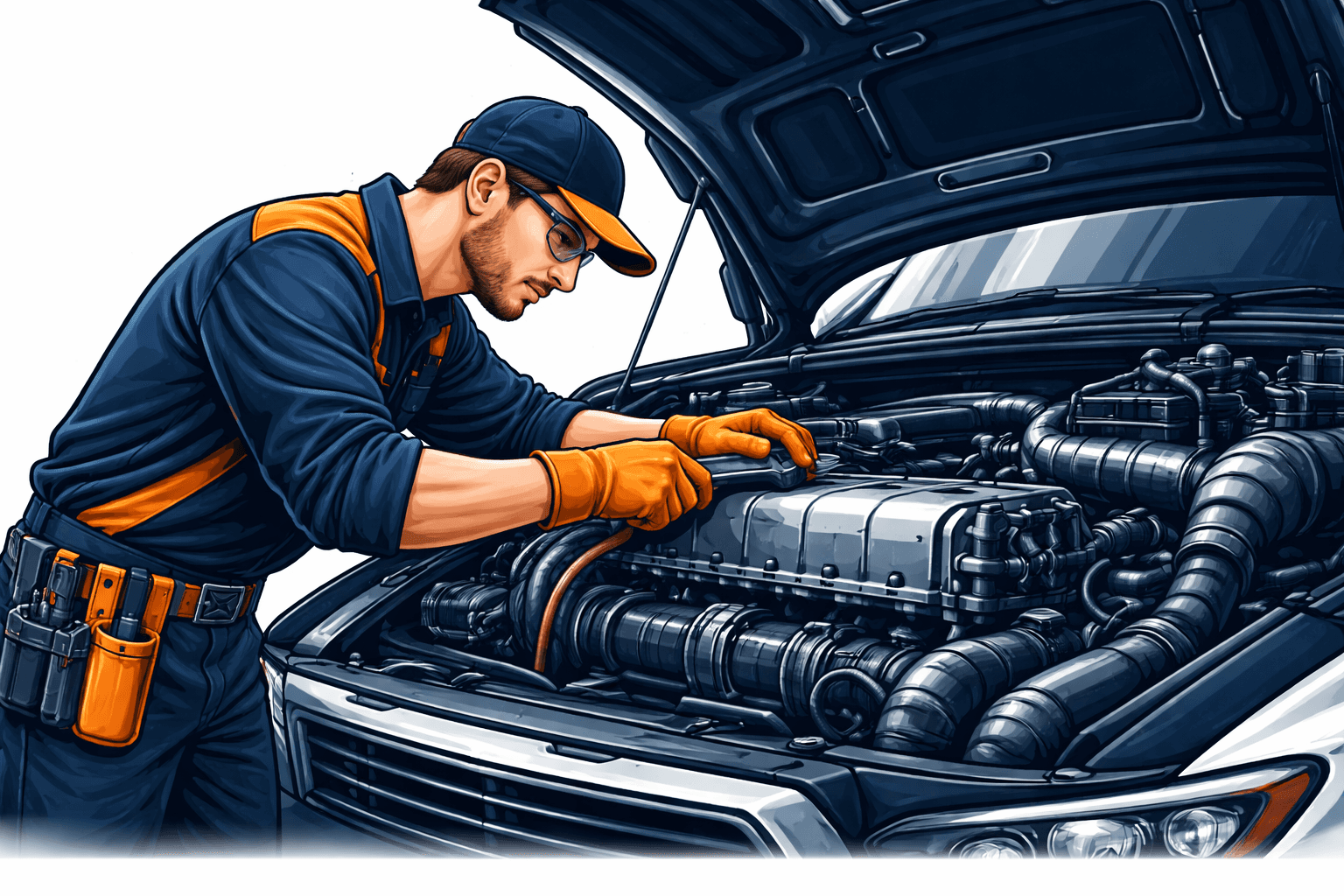
Turbocharged engines are everywhere now. Almost every new car, from economy sedans to full-size trucks, runs a turbo. A turbo dramatically changes a turbo changes an engine's maintenance needs and failure patterns. Most owners have no idea what's under the hood or what they're dealing with. This article fixes that.
The Problem Turbos Solve
An engine makes power by burning air and fuel. The more air you can get into the cylinder, the more fuel you can burn, and the more power you produce. A naturally aspirated engine - one without forced induction - is limited to however much air can be drawn in through atmospheric pressure alone. That's the baseline.
A turbocharger forces additional compressed air into the cylinders, above and beyond what atmospheric pressure provides. The result is a smaller engine that produces power comparable to a much larger engine. This is why a modern 2.0L turbocharged engine can produce 300 horsepower while a naturally aspirated 2.0L would struggle to make 160. It's also why automakers love turbos - they get the power numbers buyers want with the fuel economy regulators require.
How a Turbocharger Works
A turbocharger has two turbines - one on the exhaust side and one on the intake side - connected by a central shaft. Here's the sequence:
- Hot exhaust gases leaving the engine cylinders flow through the exhaust manifold and hit the exhaust turbine wheel. The energy in those gases spins the turbine at extremely high speed - up to 150,000 RPM in some applications.
- The exhaust turbine is bolted to the shaft, which connects directly to the compressor turbine on the intake side.
- The spinning compressor turbine pulls in fresh ambient air and compresses it - packing more air molecules into the same volume.
- That compressed air (called boost) flows through an intercooler to reduce its temperature, then into the engine's intake manifold and cylinders.
- More air in the cylinder means more fuel can be injected, and more fuel means a bigger controlled explosion and more power.
The key concept is that a turbo runs on what would otherwise be wasted energy - the heat and velocity of exhaust gases being expelled from the engine. It recovers that energy and uses it to make the engine more powerful and efficient.
What Is Boost?
Boost is the amount of pressure above atmospheric that the turbocharger adds to the intake air. It's measured in PSI (pounds per square inch) or bar. A typical street car might run 8 to 15 PSI of boost. A high-performance application might run 20 to 30 PSI. Higher boost means more air, more fuel, more power - but also higher cylinder pressure and heat, which is why high-boost engines need stronger internals.
A wastegate controls how much boost the turbo produces. When boost reaches the target pressure, the wastegate opens and diverts some exhaust gas away from the turbine wheel, preventing the turbo from spinning faster and building more pressure. On modern vehicles, this is controlled electronically by the engine management system.
Turbos vs Superchargers
Both force more air into the engine - both are called forced induction - but they're powered differently.
A turbocharger is driven by exhaust gases. It uses waste energy. The tradeoff is turbo lag - a brief delay in power delivery at low RPM while exhaust flow builds up enough to spin the turbo to operating speed. Modern turbos have significantly reduced lag compared to older designs, but it's still a characteristic of the technology.
A supercharger is mechanically driven by the engine's crankshaft - typically via a belt, like an alternator or power steering pump. Because it's tied directly to engine speed, power delivery is instant with no lag. The tradeoff is efficiency: the supercharger consumes engine power to operate, whereas the turbo uses exhaust energy that would otherwise be lost.
Neither is universally better. Turbos dominate modern production cars because of their efficiency advantage. Superchargers are common in high-performance and muscle car applications where immediate throttle response is valued over fuel efficiency.
What Turbos Mean for Maintenance
A turbocharger fundamentally changes your engine's maintenance requirements. This is where many owners get into trouble.
Oil changes are more critical. The turbo's central shaft and bearings are lubricated entirely by engine oil. That shaft spins at up to 150,000 RPM in a bearing housing that gets extremely hot. Old, degraded oil cannot properly lubricate these bearings and breaks down under the heat. Turbo bearing failure from neglected oil changes is one of the most common - and preventable - turbo failures I see. Follow the manufacturer's oil change interval closely, and use the recommended oil specification. Most turbocharged engines require full synthetic oil.
Let the engine warm up. When you first start a cold engine, oil pressure takes a moment to build. The turbo is one of the last components to receive lubrication. Avoid flooring a turbocharged engine immediately from a cold start. A minute of easy driving lets oil pressure and temperature stabilize. For a full breakdown of turbocharged engine service intervals and oil specifications, the APEX Tech Nation article library covers it in detail.
Do not shut the engine off immediately after hard driving. When you shut the engine off, oil pressure drops to zero instantly. But the turbo keeps spinning due to its own momentum - sometimes for 30 to 60 seconds. Without oil flow, the bearings spin dry and the residual heat bakes any oil in the housing into carbon deposits called coking. Over time, coked oil destroys turbo bearings. Most normal driving doesn't require a cool-down period, but after sustained hard driving - track days, towing, mountain grades - give the engine a few minutes at idle before shutting off.
Watch for boost leaks. All the intercooler piping, couplers, and charge pipes that carry compressed air from the turbo to the engine are under pressure and subject to vibration. Cracked hoses or loose clamps cause boost leaks, which reduce power and can trigger check engine lights. A hissing sound under hard acceleration is often the first sign.
Signs of Turbo Problems
- Blue or grey smoke from the exhaust - Oil getting past the turbo seals into the intake or exhaust. Points to worn turbo seals or bearings.
- Whining or grinding noise - Failing turbo bearings produce a high-pitched whine, distinct from normal turbo operation. Grinding indicates more advanced bearing wear.
- Loss of power with no check engine light - Can indicate a boost leak or a wastegate stuck open, allowing boost to bleed off before reaching the engine.
- Check engine light with boost-related codes - A P0299 (underboost) or P0234 (overboost) code points directly to turbo or boost control system issues.
The Bottom Line
A turbocharger is a precision component spinning at extreme speeds under extreme heat. It rewards regular oil changes and punishes neglect. If you drive a turbocharged vehicle - and there's a good chance you do - treat it like what it is: a high-performance engine that needs clean oil, proper warm-up habits, and attention to any unusual sounds or smoke. Do that and a turbo will last the life of the engine.