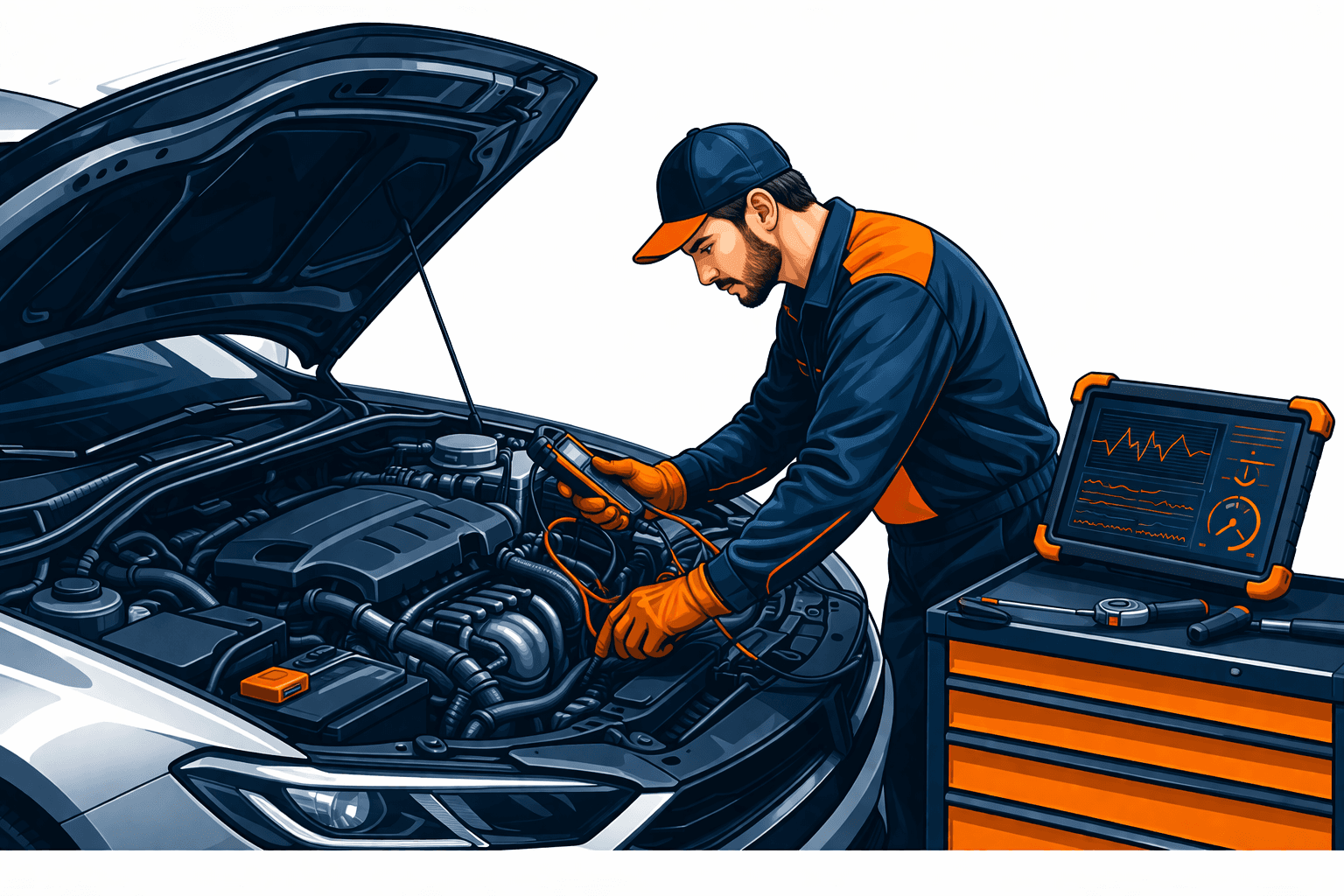
The ABS light is one of those warning lights that people either panic about or completely ignore. Neither reaction is quite right. Let me give you the real picture - what the system does, why the light comes on, and exactly what you should do about it.
What ABS Actually Does
ABS stands for Anti-lock Braking System. Before ABS became standard equipment in the 1990s, if you slammed on the brakes in an emergency, the wheels would lock up. Locked wheels don't steer - the car just slides in whatever direction it was already going. You had no ability to steer around an obstacle because all four wheels were dragging on the pavement.
In a panic stop, a properly functioning ABS system can reduce stopping distance and - more importantly - keep you in control of where the car goes. It's a genuine safety feature, not marketing.
Why the ABS Light Comes On
The ABS light illuminates when the ABS control module detects a fault in the system and disables the anti-lock function. Your regular brakes still work - you haven't lost braking ability. But the anti-lock function is offline. The system stores a fault code that tells the tech exactly where the problem is.
The main causes, in order of how often I see them:
- Failed wheel speed sensor (by far the most common)
- Damaged wheel speed sensor wiring or tone ring
- Low brake fluid
- Failed ABS control module
- Failed ABS pump or hydraulic unit
- Bad wheel bearing (destroys the tone ring)
Wheel Speed Sensor Failure
If I had to guess without scanning the car, I'd bet on a wheel speed sensor nine times out of ten. These sensors are mounted at each wheel, pointed at a toothed ring (called a tone ring or reluctor ring) that spins with the wheel. As the teeth pass the sensor, it generates a signal the ABS module reads as wheel speed.
Wheel speed sensors live in a brutal environment. They sit close to the ground, exposed to water, road salt, mud, and heat cycles from the brakes. The sensor itself can fail, the wiring harness can chafe through and short or open, or the connector can corrode. Any of these kills the signal and triggers the ABS light.
The Tone Ring
The tone ring - the toothed ring the sensor reads - can also crack, chip, or get coated with rust and debris. A missing tooth or damaged tone ring gives the module a false speed reading, triggering ABS faults. On many vehicles the tone ring is integrated into the wheel bearing hub. If the bearing is being replaced, inspect the tone ring closely.
Diagnosing the Sensor
A tech will pull the ABS fault codes from the module with a scan tool. The code will identify which wheel's sensor is the problem (left front, right rear, etc.). They'll then test the sensor's resistance and signal output, inspect the wiring, and visually check the tone ring. On most vehicles this is a straightforward diagnosis that takes 30–45 minutes.
ABS Control Module Problems
The ABS control module is the computer that receives sensor data and controls the hydraulic unit during ABS events. It's a more serious and expensive failure than a sensor, but it happens.
Module failures often show up as multiple ABS codes across more than one wheel - not just one wheel sensor. Or the module may fail to communicate entirely. On some vehicles (certain GM trucks, for example), the ABS module has a known failure mode related to internal circuit board corrosion from moisture intrusion.
Module replacement or rebuild is expensive - often $400–$1,200 for the part alone on top of labor. Some companies offer remanufactured modules at lower cost. Make sure you're getting the right part programmed for your vehicle's VIN, as some modules require programming after installation.
Low Brake Fluid and Hydraulic Issues
The ABS system uses brake fluid pressure to modulate the brakes. If brake fluid level drops low enough, a sensor in the brake master cylinder reservoir triggers the ABS light along with the brake warning light. This is a signal you need to take seriously - brake fluid doesn't get consumed, so a low level means you have a leak somewhere in the brake system.
Check your brake fluid reservoir. It's a small translucent plastic reservoir under the hood, usually near the driver's side firewall. There's a min and max line. If it's below the min line, you likely have a brake fluid leak (caliper, wheel cylinder, brake line, or master cylinder) that needs immediate attention.
ABS Hydraulic Unit
The ABS hydraulic unit contains the pump, valves, and accumulators that physically modulate brake pressure during an ABS event. Internal valve failures or pump motor failure can trigger the ABS light. This is a significant repair - hydraulic unit replacement typically runs $600–$1,500 at a shop. Make sure the diagnosis is solid before approving this repair, because it's expensive.
Can You Drive With the ABS Light On?
Yes - with an important qualification. When the ABS light is on, the anti-lock function is disabled. Your regular brakes work normally. In everyday driving, you won't notice any difference. The ABS only activates during hard emergency stops.
What that means practically:
- In normal driving, stopping at a light, slow-speed braking: no difference
- In a panic stop or on wet or icy roads: you lose the anti-lock protection. Your wheels can lock up and you lose steering control during that stop. This is how cars skidded before ABS was invented.
My honest take: don't leave it broken indefinitely. The ABS is there for emergencies, and emergencies don't schedule themselves. If you live somewhere with snow and ice, or if you do any significant highway driving, get it fixed. It's a safety system. If money is tight, it's not a "pull over right now" situation - but put it on the list for repair within the next few weeks.
One critical exception: if the ABS light is on along with the regular red brake warning light, stop driving and have it towed. Two lights together often means a hydraulic failure or severe fluid loss - that's your regular braking system at risk.
ABS, Traction Control, and StabiliTrak
This confuses a lot of people. Traction control and electronic stability control (ESC/StabiliTrak/VSC) share the same wheel speed sensors and hydraulic hardware as ABS. They're all part of the same integrated system.
When the ABS light comes on, it's very common for the traction control light and/or stability control light to also illuminate - sometimes as a separate warning, sometimes combined. This happens because those systems can't function without accurate wheel speed data. One sensor failure can knock out ABS, traction control, and stability control simultaneously.
Don't panic if you see multiple lights at once. It often traces back to a single wheel speed sensor. The fault codes will identify it precisely.
Repair Costs
- ABS diagnostic scan and inspection: $80–$150
- Wheel speed sensor replacement (per wheel): $150–$350 parts and labor
- Wiring harness repair (chafed or shorted wire): $100–$300 depending on severity
- Wheel hub assembly with integrated tone ring: $250–$550 (also replaces the bearing)
- ABS control module replacement: $400–$1,200+ depending on vehicle; add programming cost
- ABS hydraulic unit replacement: $600–$1,800
- Brake fluid flush (if low/contaminated): $80–$150
Wheel speed sensors are the most common fix and among the cheapest. Get a diagnosis before assuming the worst - most ABS lights are a sensor, not a module.
For more on dashboard warning lights and what they actually mean, visit APEX Tech Nation - a resource built by technicians who've seen these failures firsthand, not writers Googling symptoms.