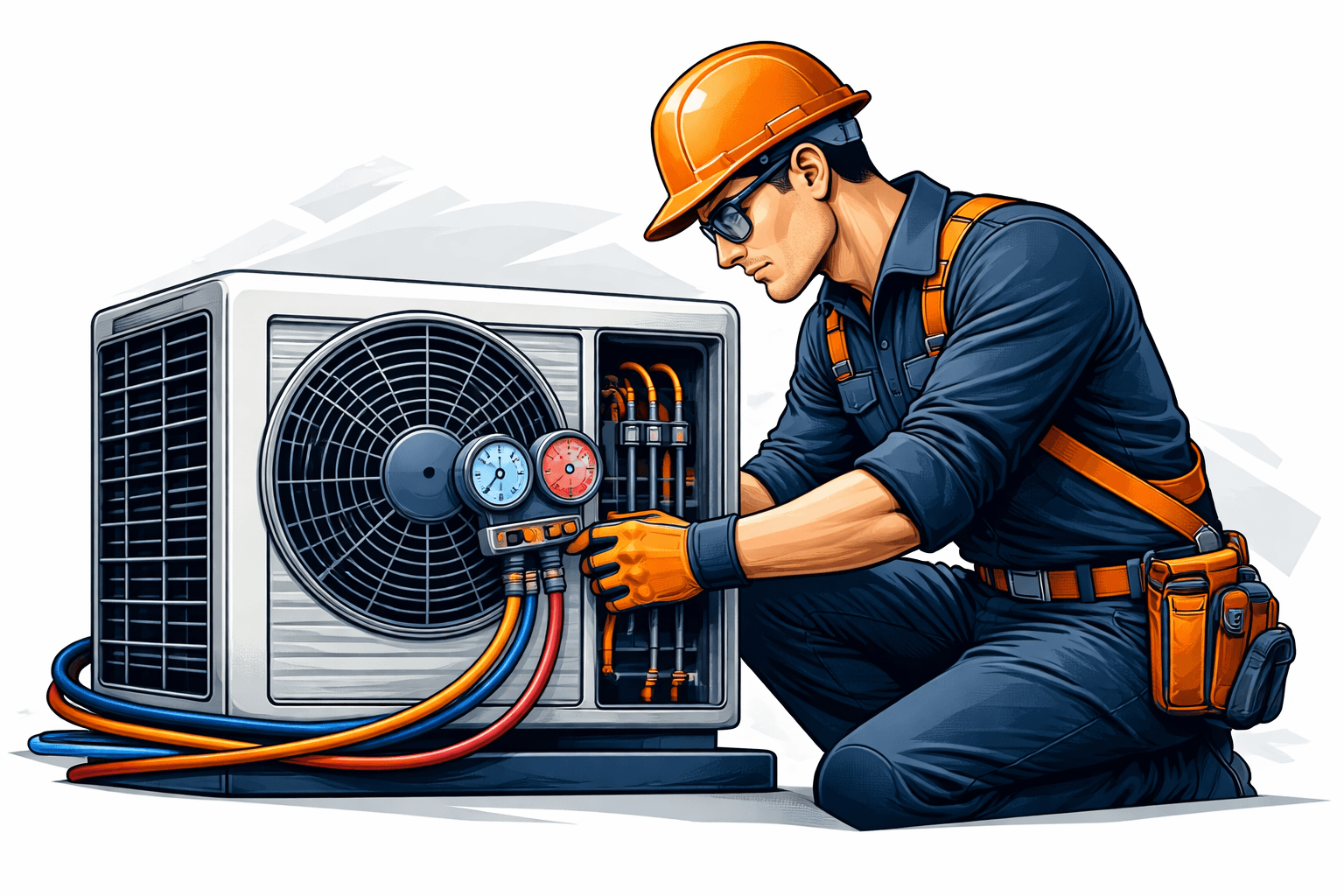
Every summer, my shop fills up with cars that aren't blowing cold air, and almost every customer who walks in says the same thing: "I think it just needs Freon." Sometimes that's partially right. Most of the time, there's more to the story. Let me explain how your AC actually works so you understand what's happening when it stops cooling and why the fix isn't always as simple as adding refrigerant.
How Your Car's AC System Works
Your car's AC system works on the same basic principle as your refrigerator at home: it doesn't actually create cold air. Instead, it removes heat from the air inside your cabin and dumps it outside. It does this by exploiting a simple physics principle - when a liquid evaporates into a gas, it absorbs heat, and when a gas is compressed into a liquid, it releases heat.
The AC system circulates a special fluid called refrigerant through a closed loop. The refrigerant constantly changes between liquid and gas form as it cycles through the system. When it evaporates inside the car, it absorbs heat from the cabin air. When it condenses outside the car, it releases that heat into the outside air. That's it - it's a heat mover, not a cold maker.
The system has four main components that make this cycle work: the compressor, condenser, expansion valve (or orifice tube), and evaporator. Let me walk you through each one.
The Refrigerant Cycle - Step by Step
Step 1: The Compressor. The compressor is the heart of the AC system - literally an engine-driven pump. It's bolted to the engine and driven by the serpentine belt (or by an electric motor in hybrids and EVs). When you press the AC button, the compressor clutch engages and the compressor starts pumping.
The compressor takes low-pressure refrigerant gas from the evaporator and compresses it into high-pressure, high-temperature gas. We're talking about 150 to 250 PSI on the high side and temperatures around 150 to 200 degrees Fahrenheit. By compressing the gas, we've concentrated the heat it absorbed from the cabin, making it much hotter than the outside air. This is important for the next step.
Step 2: The Condenser. The high-pressure, superheated refrigerant gas flows from the compressor to the condenser. The condenser looks like a small radiator and sits right in front of your engine's radiator at the front of the car. As air flows through the condenser (from driving or from the condenser fan), the refrigerant cools down and condenses - it changes from a high-pressure gas to a high-pressure liquid.
The heat that the refrigerant absorbed from your cabin is released into the outside air here. That's why you can sometimes feel hot air blowing from the front of your car when the AC is running - that's the heat from inside your car being dumped outside.
Step 3: The Receiver/Drier or Accumulator. After the condenser, the refrigerant passes through either a receiver/drier (in expansion valve systems) or an accumulator (in orifice tube systems). This component removes any moisture from the refrigerant and filters out debris. Moisture in the system is a big problem - it can freeze at the expansion valve and block refrigerant flow, or it can combine with refrigerant to form corrosive acids.
Step 4: The Expansion Valve or Orifice Tube. This is where the magic happens. The high-pressure liquid refrigerant passes through a very small restriction - either a thermostatic expansion valve (TXV) or a fixed orifice tube. This restriction causes the pressure to drop dramatically. When pressure drops, the refrigerant's boiling point drops too - well below freezing.
Think of it like an aerosol can. When you spray a can of compressed air duster, the can gets ice cold. Same principle - rapid pressure drop causes rapid cooling.
Step 5: The Evaporator. The now low-pressure, extremely cold refrigerant enters the evaporator - another small radiator, but this one is located inside the dashboard behind the glove box area. The blower motor fan pushes cabin air across the evaporator's cold fins. The refrigerant absorbs heat from that air and evaporates from a liquid back into a gas. The air coming off the evaporator is cold and dry - the evaporator also removes humidity from the air, which is why you see water dripping under your car on hot days (that's condensation draining from the evaporator).
Step 6: Back to the Compressor. The refrigerant, now a low-pressure gas carrying heat from the cabin, returns to the compressor through the suction line, and the cycle starts all over again. This cycle repeats continuously while the AC is running.
Types of Refrigerant
You can't just use any refrigerant in your car. Here's what you need to know:
R-12 (Freon). The original automotive refrigerant, used from the 1930s until 1994. It was phased out because it depletes the ozone layer. If you have a vehicle from 1994 or earlier that still has an R-12 system, it needs to be converted to R-134a - R-12 is no longer manufactured and existing stocks cost $50 to $100+ per pound. Technically, "Freon" is a brand name for R-12, but people use it generically to mean any AC refrigerant.
R-134a. This replaced R-12 starting in 1994 and has been the standard for decades. It doesn't damage the ozone layer but does have a high global warming potential. It's relatively inexpensive - about $5 to $15 per pound. Most cars from 1994 to about 2015 use R-134a.
R-1234yf. The newest automotive refrigerant, phased in starting around 2014-2015 and now required on all new vehicles sold in the US. It has a much lower global warming potential than R-134a. The downside: it's significantly more expensive - $50 to $100+ per pound - and it requires different (more expensive) service equipment. This is why AC service on newer vehicles costs more than it used to.
Your vehicle has a label under the hood (usually on the AC compressor or near the radiator support) that tells you exactly which refrigerant it uses. Never mix refrigerants - it will damage the system and contaminate the refrigerant, making it unrecoverable and creating a very expensive problem.
Common AC Failures and What Causes Them
Refrigerant Leak. This is the most common reason for AC losing its cooling. Since the system is sealed, any loss of refrigerant means there's a leak. Common leak points include O-ring connections (especially at the compressor and hose fittings), the condenser (road debris hits it since it's at the front of the car), the evaporator (corrosion over time), and the Schrader valve service ports. Finding the leak requires a UV dye test or electronic leak detector. Never just keep adding refrigerant without fixing the leak.
Compressor Failure. The compressor is a mechanical pump with moving parts, and it will eventually wear out. Symptoms include no cooling at all, a grinding or squealing noise when the AC is on, or the compressor clutch not engaging. Compressor failure is often caused by running the system low on refrigerant (the refrigerant carries oil that lubricates the compressor) or by contamination from a previous component failure. When a compressor fails catastrophically, it can send metal debris throughout the system, requiring a complete system flush before installing the new compressor.
Condenser Damage. The condenser sits right behind the grille and takes the brunt of road debris. A rock hit can puncture one of the thin tubes, causing a leak. Condenser replacement is common on vehicles with 80,000+ miles, especially if they do a lot of highway driving.
Blend Door Actuator Failure. This is a sneaky one that's not actually an AC system failure at all. The blend door is a flap inside the dashboard that controls how much air passes over the heater core versus the evaporator. It's moved by a small electric motor called an actuator. When the actuator fails, the blend door can get stuck in the heat position, mixing hot air with cold - or even directing all air through the heater core. Symptoms include warm air from the vents despite the AC compressor running, or different temperatures from different vents, or a clicking sound from inside the dashboard. I see this a lot, and it's often misdiagnosed as a "needs Freon" problem.
Expansion Valve or Orifice Tube Clog. Debris or moisture in the system can clog the expansion valve or orifice tube, restricting or blocking refrigerant flow. Symptoms include poor cooling, icing on the AC lines (a visible frost on the larger suction line near the firewall), or the compressor cycling on and off rapidly.
Need help figuring out what's wrong with your AC? The diagnostic resources at APEX Tech Nation can help you narrow it down before heading to a shop.
Why "Just Adding Freon" Doesn't Fix It
This is the most important section of this article, so pay attention. Every summer I have customers come in asking for a "Freon top-off" or saying they just bought a can from the auto parts store and charged it themselves but it's still not cold. Here's why that approach usually fails:
The system is sealed - if it's low, it's leaking. Your AC system doesn't consume refrigerant like your engine consumes oil. The refrigerant circulates in a closed loop. If the refrigerant level is low, it leaked out somewhere. Adding more refrigerant without finding and fixing the leak is like adding air to a tire with a nail in it. You're just refilling what's going to leak out again - and you're venting refrigerant into the atmosphere, which is actually illegal under the Clean Air Act.
DIY cans cause more problems than they solve. Most cans sold at auto parts stores include "stop leak" sealant. This sealant can clog your expansion valve, damage your compressor, and gum up the system. It also contaminates the refrigerant, which means when a technician eventually works on your system, the contaminated refrigerant can't be recycled and their recovery machine has to be decontaminated. Many shops will charge extra or refuse to work on a system that's had stop-leak added. I've seen stop-leak damage turn a $300 repair into a $1,500 system replacement.
Overcharging is just as bad as undercharging. Without proper manifold gauges, you can't know the correct charge level. Too much refrigerant causes excessively high pressures that can damage the compressor and reduce cooling efficiency. The system is designed for a specific charge amount, measured in ounces. A few ounces too much or too little makes a noticeable difference.
The actual problem might not be the refrigerant at all. As I mentioned, a failed blend door actuator, a bad condenser fan, a clogged cabin air filter, or an electrical issue can all cause warm air from the vents - and none of those are fixed by adding refrigerant. Proper diagnosis with manifold gauges, temperature readings, and system testing is the only way to know what's actually wrong.
Do yourself a favor: skip the $30 can at the parts store and put that money toward a proper AC diagnosis at a shop. A diagnostic typically costs $50 to $150 and will tell you exactly what's wrong and what it'll cost to fix correctly.
AC Repair Cost Breakdown
Here's what you can expect to pay for common AC repairs:
- AC diagnostic and leak test: $50 to $150
- Refrigerant recharge (after leak repair): $150 to $300 (higher for R-1234yf vehicles)
- O-ring or Schrader valve replacement: $100 to $250
- Condenser replacement: $400 to $900
- Compressor replacement: $800 to $1,500
- Evaporator replacement: $900 to $2,000+ (labor-intensive - the dashboard has to come out)
- Expansion valve or orifice tube: $200 to $500
- Blend door actuator: $200 to $500
- Receiver/drier or accumulator: $150 to $350
These prices include parts and labor for most common vehicles. Luxury vehicles, European cars, and vehicles with rear AC (dual-zone systems in SUVs and minivans) will be at the higher end or above these ranges.
AC Maintenance Tips
Your AC system doesn't need a ton of maintenance, but a few things can extend its life:
Run your AC regularly. Even in winter, run your AC for 10 to 15 minutes every couple of weeks. The compressor has seals that need lubrication from the oil circulating in the refrigerant. If the compressor sits for months without running, those seals can dry out and start leaking. Plus, running the AC dehumidifies the air, which helps keep your windshield clear in cold weather.
Replace your cabin air filter. A clogged cabin air filter restricts airflow across the evaporator, reducing cooling and making the system work harder. It also causes that stale smell. Most cabin filters should be replaced every 15,000 to 20,000 miles - and it's usually a 5-minute job you can do yourself. Check your owner's manual for the location and interval.
Park in the shade when possible. A car parked in direct sun can reach 150 degrees or more inside. That's a lot of heat your AC has to remove before you feel comfortable. Parking in shade or using a windshield sunshade reduces the initial heat load on the system.
Don't ignore reduced cooling. If your AC starts blowing less cold than it used to, don't wait until it stops completely. Catching a small leak early is much cheaper than waiting until the compressor runs dry and seizes. A slowly declining AC is telling you something - listen to it.
Your car's AC system is more complex than most people realize, but it's reliable when maintained properly. Understand how it works, don't fall for the "just add Freon" shortcut, and get proper service when something isn't right. Your future self, sitting in a cool car on a 100-degree day, will thank you.